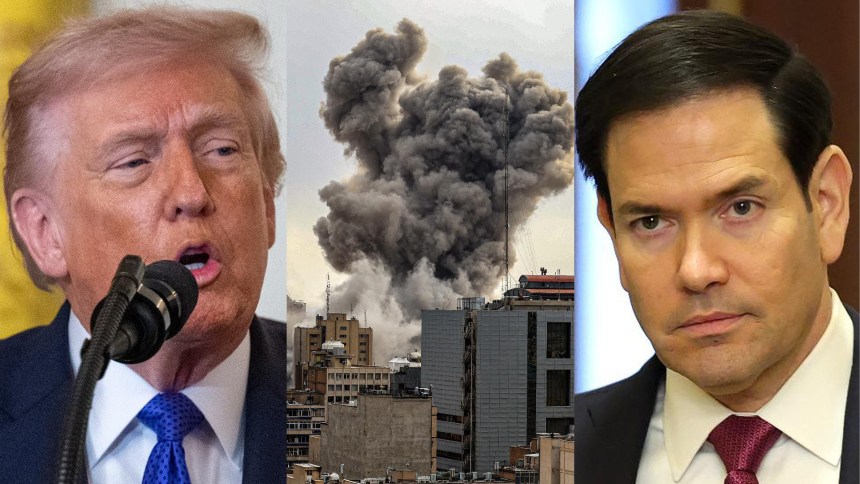
Secretary of State Marco Rubio made a stunning claim Tuesday afternoon about the U.S. war with Iran — it’s Israel’s fault.
According to Rubio, “We knew that there was going to be an Israeli action, we knew that that would precipitate an attack against American forces, and we knew that if we didn’t preemptively go after them before they launched those attacks, we would suffer higher casualties.”
In making these comments, Rubio not only threw a key ally under the bus, but he unintentionally or not leaned into a millennia-old antisemitic trope that Jews operate, insidiously, behind the scenes in pushing governments into actions that are bad for them but good for Jews. It’s imperative that he and those — particularly on the political left — who amplified them understand how dangerous they were and the role they could play in promoting antisemitism today.

At the outset, it must be said that Rubio’s statement, if taken at face value, is ludicrous. The U.S. has been building up military assets in the Middle East for months, in preparation for a potential war with Iran. Administration officials repeatedly leaked news stories that Trump was looking to attack Iran. Moreover, at the same press conference in which he suggested that the tail of Israel is wagging the American dog, Rubio made clear, “This operation needed to happen,” because of Iran’s missile development program. According to the secretary of state, “we were aware of Israeli intentions and understood what that would mean for us, and we had to be prepared to act as a result of it. But this had to happen no matter what.” (Italics mine.)
Rubio’s claims of an Iranian retaliation make even less sense. Why would Iran, if attacked by Israel, respond by attacking “American forces,” needlessly antagonizing the United States? In June, when Israel launched its first strikes on Iran, Tehran didn’t respond by attacking U.S. targets in the region. After the U.S. joined Israel in attacking Iran’s nuclear facilities, the Iranian military response was limited and highly calibrated to avoid a larger conflict. Why would they act differently now?
Above all, however, Rubio’s statement is an abdication of responsibility. Ultimately, any decision to use American military force rests with President Donald Trump.
Has Israeli Prime Minister Benjamin Netanyahu lobbied for America to join Israel in attacking Iran? Unquestionably, yes. But Israel is hardly the first foreign ally to try to cajole America into acting on its behalf. If Israel’s actions risked putting the U.S. in danger, Trump certainly could have told Netanyahu to cease and desist. That he didn’t is on him. Last time I checked, America is still the superpower in this relationship.
From the moment Rubio made his comments, I was inundated with horrified messages from friends and family about the potential danger that his words could have for the Jewish community in America.
However, what was perhaps most disturbing about Rubio’s self-serving statement was that it was immediately picked up and amplified by the same Democrats and progressives who are usually deeply skeptical of every statement made by members of the Trump administration. Sen. Ruben Gallego, D-Ariz., posted to X: “So Netanyahu now decides when we go to war? So much for America First.” Sen. Mark Warner, D-Va., suggested that the war with Iran was one of choice “dictated by Israel’s goals and timeline.” At the same time, a host of prominent progressive commentators took to social media to blame Israel for the war, based largely on Rubio’s statement.
This is, as American Jews are prone to say, “bad for the Jews.”
Indeed, from the moment Rubio made his comments, I was inundated with horrified messages from friends and family about the potential danger that his words could have for the Jewish community in America.
After all, we’ve seen this movie before.
One of the founding documents of modern antisemitism is the “The Protocols of the Elders of Zion,” a fabricated record of meetings in which the “learned elders of Zion” plot to control world politics, manipulate the economy and financial markets and keep the world in a perpetual state of war, all to benefit them. It is a claim that was embraced by Adolf Hitler to justify the elimination of European Jewry. The Jews had, argued the Nazi leader, pushed the world into war in 1914 and, if not stopped, would do it again.
More recently, in the run-up to the 2003 Iraq War, conspiracy theorists frequently blamed “Jewish influence” for the decision to go to war, in part because some of then-President George W. Bush’s close advisers were Jewish (it bears noting that the Israeli government, at the time, counseled Bush not to invade Iraq).

For those inclined to believe that Jews run the world and act as surreptitious puppet masters, Rubio’s comment was conspiratorial catnip. His comments and their promotion risk putting a target on the backs of American Jews.
If the war goes on for weeks or months, if casualties mount and if Americans face higher prices at gas stations, it’s not hard to imagine that they begin to blame not just Trump, but also those who are perceived to have pushed him into war. Some will argue that blaming Israel and Diaspora Jews are not the same thing. But as we’ve seen over the past two and a half years, since Hamas’ attack on Israel on Oct. 7, 2023, anti-Israeli sentiment has repeatedly morphed into criticism and attacks on Diaspora Jews.
Indeed, antisemitic hate crimes have increased dramatically since Oct. 7 and not just in the U.S., but around the world.
For those inclined to believe that Jews run the world and act as surreptitious puppetmasters, Rubio’s comment was conspiratorial catnip.
In fairness, it’s quite possible, even likely, that neither Rubio nor Gallego nor Warner understood the implications of their statements or how they might be interpreted by those who are antisemitic. Antisemitism is, after all, a thousands-year-old conspiracy theory that is baked into Western discourse. What Jews see and understand to be long-standing antisemitic tropes, non-Jews may see as appropriate criticism of Israel.
And make no mistake, there are certainly appropriate grounds on which to criticize Israel and, in particular, Netanyahu for pushing the U.S. to join it in attacking Iran. Criticism of Israel’s policies is not inherently antisemitic, but when that criticism promotes, even unintentionally, anti-Jewish tropes, it is a much more serious problem.
Those in the public sphere, whether they are the secretary of state, a senator or even political pundits with large platforms, need to better understand how their criticisms of Israel resonate with those who are antisemitic and play into antisemitic conspiracy theories.
Moreover, when Jews raise concerns about this kind of rhetoric, they should be listened to, not shouted down. When it comes to antisemitism and the horrible consequences of such toxic beliefs, we know of where we speak.