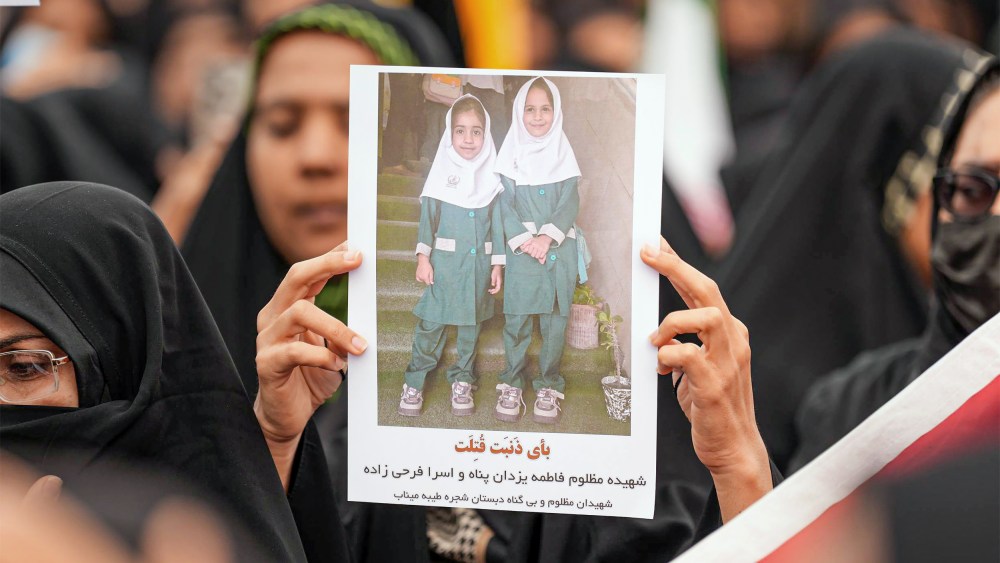
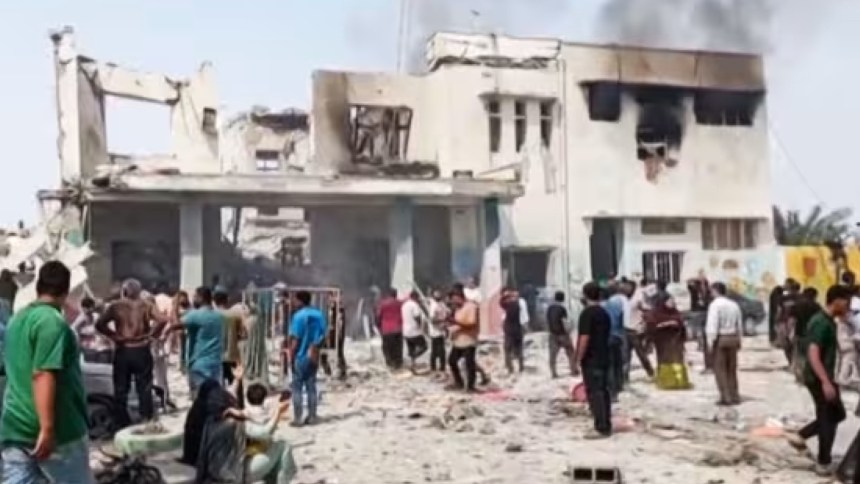
Among some of the most disturbing and gruesome initial scenes from the chaotic war the U.S. and Israel unleashed on Iran was the bombing of a girls’ elementary school on Saturday. The strike reportedly killed at least 175 and left 95 injured. Thousands of Iranians have turned out this week for funerals. Images and reports of young girls strewn across classroom floors and parents clinging to their remains horrified many around the world. As these deaths are considered, it should not be missed: This tragedy typifies the role and exploitation of gender in imperialism, both practically and in abstraction.
Narratives around the war on Iran tap into two critical gendered tropes that are essential to the imperial project: The first is the category of the “Muslim woman,” refracted through the Western gaze, who is in need of saving. The second trope implicitly genders “the West” as masculine and “the East” as feminine. (While categories such as “the East” and “the West” offer a shorthand when discussing the global order, I’ve placed them in quotation marks as they, themselves, are imagined categories that have colonial and imperial genealogies, rooted in a harmful binary.)
The stereotype of the victimized and passive Muslim woman who needs saving from Muslim men has long fueled justifications for acts of war and military interventions in the Muslim world — and Iran is no exception.
The stereotype of the victimized and passive Muslim woman who needs saving from Muslim men has long fueled justifications for acts of war and military interventions in the Muslim world — and Iran is no exception.
While the brutalities of the Iranian government are not to be underemphasized, representations of Iranian women in so-called Western media have reproduced these narratives and have helped justify the bombings. In discussing Palestinian American anthropologist Lila Abu-Lughod’s “Do Muslim Women Really Need Saving?” the historian Marya Hannun writes that “Western” media narratives depict “Muslim women’s suffering at the hands of Muslim men as a problem of culture and religion ‘over there,’ devoid of political, historical, and even geographic context.” Hannun adds, “The only solution was a singular idea of liberation, one that served the U.S. occupying forces.” (This is not to excuse the atrocities of the Iranian government but, rather, to insist that they be contextualized and situated outside of the imperial gaze.)
Furthermore, in his pioneering work, “Orientalism,” the late Edward Said argued that gender is absolutely essential to the imperial project, whereby “the West,” or the Occident, is portrayed as rational, scientific, masculine and dominating, and the Orient as irrational, “passive, seminal, feminine, even silent and supine,” and in need of domination.
And yet these imperialist military interventions in the Muslim world and beyond were the same efforts that produced the conditions that allowed for profound gender disparities — and they are the very same that allow them to endure. They create the unstable conditions that, through the prism of modern-day imperialism, justify more war and invasions.
In the case of Iran, the 1979 revolution, which led to the establishment of the Islamic Republic, followed a U.S.- and U.K.-backed coup that overthrew the anti-colonialist socialist Prime Minister Mohammad Mosaddegh and his democratically elected government. Mosaddegh wanted to nationalize a majority British oil company that later became BP. The coup facilitated the consolidation of power under Mohammad Reza Pahlavi, the last shah of Iran. Pahlavi was widely criticized for being a Western stooge. Pahlavi’s reign was arguably no less repressive than what followed. Outrage at Pahlavi and the concomitant “Western” exploitation led to the 1979 revolution, which in turn led to the formation of the modern state, responsible for oppressive policies and deploying violence against its citizens.

It should also be noted that the genesis of Iran’s nuclear program began with U.S. support in 1957. The United States supplied the country with “a nuclear reactor and uranium to fuel it,” as this Al Jazeera timeline explains. In this way, we can begin to see how U.S. involvement in the region directly created the conditions that are part of the justification for this war.
As the fatalities from the strike on the girls’ elementary school remind us, women and girls are often among the first to bear the burden of violence and political upheaval. Here, the tragedy evinces the bad-faith exploitation of gender in the modern imperial project. The U.S., the narrative holds, is acting to help save the “oppressed Muslim woman” — among other things — yet ends up hitting a girls’ school. The Israeli and U.S. statements that they’ll “investigate” and evasions on responsibility speak volumes. This strike is a reminder of the fallacy of gender equality and liberation for which “the West” is purportedly a beacon and the pattern of exploitation of women and girls to justify horrific acts of violence. In the absence of any meaningful or actionable plan to support Iranians in creating an alternative government, the most vulnerable populations, sadly, are already paying an enormous price for this violence.