Donald Trump did everything he could think to beg the Supreme Court to approve his trade tariffs. In an op-ed for The Wall Street Journal three weeks ago, the president didn’t just make a series of dubious claims about the economic impact of his policy. He also wrote, “I sincerely hope the Supreme Court is watching these numbers.”
A week later when the Republican tried to connect his tariffs to the stock market, he issued a related plea by way of his social media platform: “I hope the United States Supreme Court is watching.” It followed a related missive in which he concluded, “If the Supreme Court rules against the United States of America on this National Security bonanza, WE’RE SCREWED!”
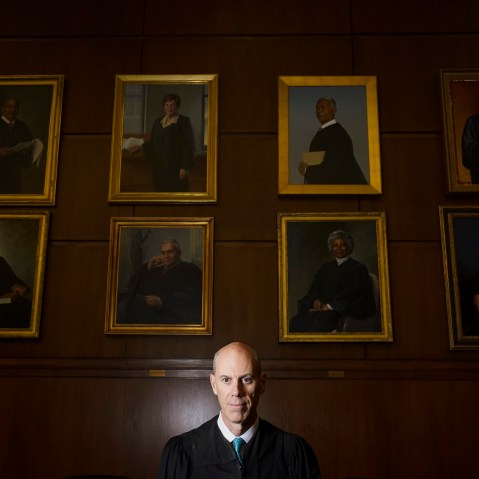
It didn’t work. In a 6-3 ruling, authored by Chief Justice John Roberts, the high court ruled that the president doesn’t have the legal authority he claimed to have. Lower courts reached the same conclusion.
Not surprisingly, the news was not well received at the White House. MS NOW confirmed that Trump was notified of Friday morning’s ruling during a meeting with governors in the State Dining Room, and he told attendees, “It’s disgraceful what the courts have done.”
Soon after, White House aides said Trump would deliver public remarks. The question wasn’t whether we’d see an enraged president, but rather, just how furious he’d be.
We didn’t have to wait long for an answer. Trump raged against justices whom he’s “absolutely ashamed” of, pointing to some kind of amorphous conspiracy in which high court justices have been swayed by foreign interests and are “a disgrace to the nation.”
He went on to call the justices in the majority “fools” and “lapdogs for RINOS and the radical left,” adding that they’re “very unpatriotic and disloyal to our Constitution.”
The president described the ruling as “ridiculous,” among other things.
What Trump doesn’t seem willing to grapple with is the degree to which this fiasco is his own fault, not the justices’.
For one thing, the president has spent several months suggesting his unilateral authority over tariffs, contrary to the language of the Constitution, is rooted in “emergency” conditions that necessitate dramatic action.
Except Trump has also routinely undermined this argument by using his policy in ways that had nothing to do with emergencies. Brazil prosecuted a politician allied with Trump? Tariffs. European countries aren’t on board with his Greenland crusade? Tariffs. France’s Emmanuel Macron isn’t interested in Trump’s “Board of Peace”? Tariffs. The Swiss president annoyed Trump during a phone meeting? Tariffs.
The president, in other words, discredited his own “emergency” pretense (to the extent that it was ever plausible in the first place).
But even more important is the legal path Trump chose to follow.
As things stand, the House and Senate are led by Republican majorities that tend to do Trump’s bidding. If the White House was correct and there was a genuine “emergency” that necessitated an ambitious tariffs agenda, the president could’ve simply made an appeal to his GOP allies on Capitol Hill.
But he didn’t, either because he feared too many Republicans would ignore him or because he wanted to assert institutional dominance by claiming a power the president did not and does not have.
Either way, Trump chose a direction that sealed his fate.
At his Friday afternoon press conference, the president continued to insist there is “no reason” for him to go to Congress on tariffs, adding “I don’t have to.” The comments suggested he’s learned very little from his historic defeat in court.
This post updates our related earlier coverage.