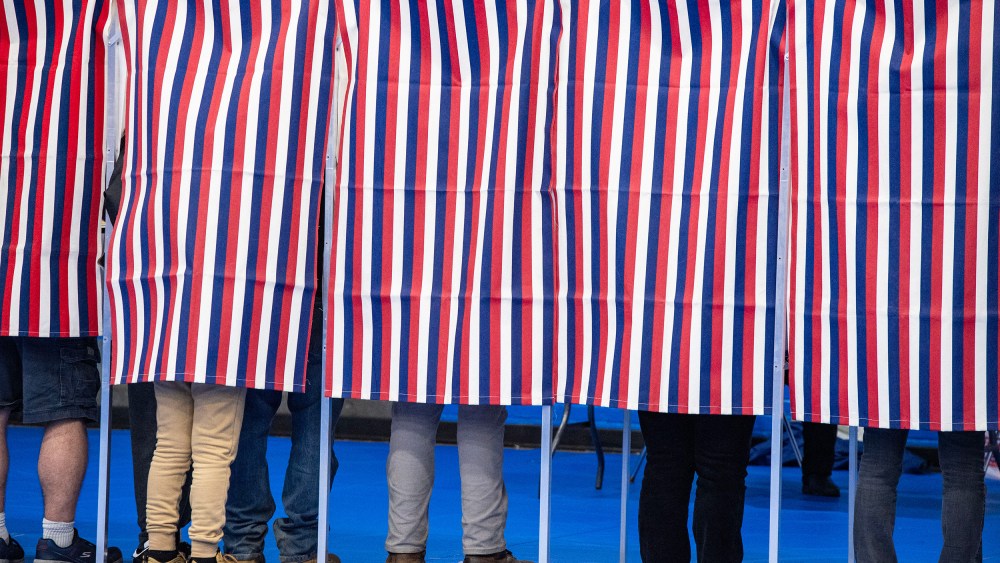
In Minnesota, state election officials are gaming out how to respond if armed agents from Immigration and Customs Enforcement show up at polling places this November.
In the nation’s capital, congressional Democrats are discussing how to respond if a Republican governor sends National Guard troops into a Democratic stronghold on Election Day to lower turnout.
And in multiple private conversations, former national security and law enforcement officials are considering the best legal strategies to defend the midterm elections against interference by Trump administration officials, including FBI agents seizing voting machines on Election Day.
President Donald Trump’s call for the GOP to “nationalize” elections is spurring many officials, lawyers and lawmakers across the U.S. to bolster their defenses against election interference. While many Republicans brush off the president’s threats, election officials are rushing to organize meetings and conference calls to prepare for scenarios in which Trump might use federal agents, troops or MAGA-aligned local officials to interfere in elections.
“This now belongs in the same category as a power outage, a bomb threat, a weather incident, because it would be irresponsible now for us not to plan what the response would look like,” Minnesota Secretary of State Steve Simon told MS NOW.
The threat of the Trump administration trying to interfere in the midterm elections is being taken seriously, he said, citing Trump’s deployment of federal agents and military personnel to some American cities and recent calls by his allies for such forces to be placed near polling stations.
“We’ve now gotten to the point, sadly, in 2026 where the process of federal interference with our elections — either directly or indirectly — is something that we have to game out and plan for,” Simon said.
In response to a request for comment, White House spokesperson Abigail Jackson said in a statement that the “Civil Rights Act, National Voting Rights Act and Help America Vote Act all give the Department of Justice full authority to ensure states comply with federal election laws, which mandate accurate state voter rolls. President Trump is committed to ensuring that Americans have full confidence in the administration of elections, and that includes totally accurate and up-to-date voter rolls free of errors and unlawfully registered non-citizen voters.”
Last Thursday, White House press secretary Karoline Leavitt said that while she hadn’t heard the president discuss plans to put ICE agents outside polling places, she “can’t guarantee that an ICE agent won’t be around a polling location in November.”
A Democratic congressional staffer said oversight committees are studying specific Election Day scenarios involving troops. This person said a Republican governor, for example, could deploy National Guard troops into large Democratic-led cities in their state, such as New Orleans or Mobile, Alabama, to reduce turnout.
“In a place like Mobile, having troops outside polling stations is going to lower turnout,” said the staffer, who spoke on condition of anonymity to discuss sensitive internal deliberations. Such an action could potentially affect the outcome of close congressional races that may determine control of the House.
A former senior national security official said the recent seizure of voting machines by Director of National Intelligence Tulsi Gabbard and FBI Director Kash Patel in Fulton County, Georgia, may have been a test run for the midterm elections.
“These are steps to essentially take over and manipulate the midterms,” said the former official, who spoke on condition of anonymity, citing fear of retaliation.
The official said Gabbard and FBI officials, for example, could declare on Election Day that they have evidence a foreign adversary is manipulating vote totals — in order to seize voting machines before votes have been counted.
“The most nightmarish thing is federal searches and seizures of voting machines on Election Day,” the former official said.
Officials sought to avoid publicly discussing the multiple methods they’re considering to counter Trump, wary of giving the administration a “road map.” But one example, Simon said, is to lean into a Minnesota law that states that only certain people — such as voters, election workers and political party observers — can be within 100 feet of the entrance to a polling place.
“Other than that, no one is allowed, even law enforcement,” Simon said. “There’s a specific provision that says law enforcement is not allowed preemptively in a polling place.”
Simon and some nonpartisan election experts said they remain confident America’s elections would continue to be carried out safely and securely in November, as they have been in the past.
“All of these efforts do not seem designed to change election policy,” said David Becker, executive director of the nonpartisan Center for Election Innovation & Research, speaking of the Trump administration’s recent efforts around voting. “They instead appear designed to create a false narrative around the election in 2026 in case the president’s party loses.”
Geoff Duncan, who served as the Republican lieutenant governor of Georgia in 2020, when Trump sought to overturn the election by lying about widespread voter fraud in the state, left the Republican Party last year and is now running for governor as a Democrat.
“Democrats and Republicans equally should be scared to death” about Trump’s recent push to “nationalize” elections, Duncan said. The efforts are about “casting doubt” on future election results, he said.
“Donald Trump is showing us the playbook,” Duncan said. “If enough Americans don’t get what he’s saying seriously, then we’re going to have a huge issue on our hands in ’26, in these midterms.”
Senate Majority Leader John Thune, R-S.D., and a handful of other Republicans have rejected Trump’s call for a federal “takeover” of elections, which the Constitution says are run by state and local officials.
Rep. Adam Smith, D-Wash., the top Democrat on the House Armed Services Committee, told MS NOW that Democrats must plan for worst-case scenarios.
Smith said discussions are underway about how to send thousands of lawyers and volunteers to polling places nationwide for the midterms, a step the party usually takes only for presidential elections.
“It is 100% what we should be focused on,” Smith said. “Democrats are preparing. We want to have lawyers and volunteers making sure people can vote.”
Ultimately, Norman Eisen, a prominent attorney and former Obama administration official, said he’s confident that every attempt by Trump to “flood the zone” to possibly interfere in the 2026 or 2028 elections would be “shut down” by “rule-of-law shock and awe.”
“These elections will be safe, free and fair,” Eisen said. “It doesn’t mean there won’t be efforts to interfere with them, but those efforts will be met by the rule of law.”