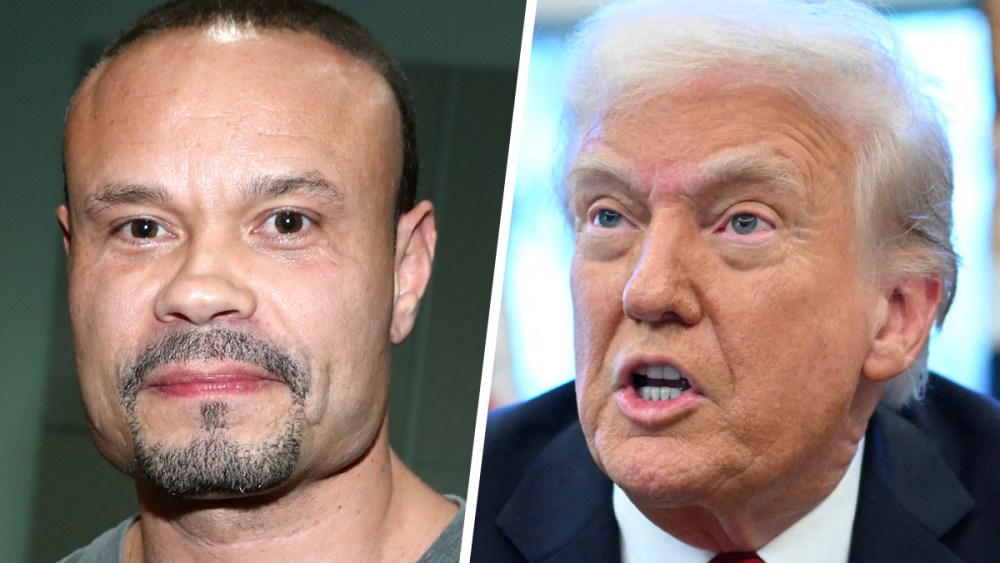
Dan Bongino is never exactly sedate, but in his first full episode since returning to the world of podcasting, his excitement was obvious — as was his relief.
“It is good to see you guys and ladies out there,” he said as the episode started. “It’s been a crazy year. I really, really missed you.”
It was a crazy year, of course, because Bongino briefly left his podcast for a slightly different gig: serving in the FBI as second-in-command to Kash Patel (another podcaster). Less than a year after he was tapped for the position by President Donald Trump, though, he was back where he felt the most comfortable: sitting behind a microphone, with no boss but himself.
And, importantly, no sworn obligation to bear true faith and allegiance to the Constitution of the United States. As deputy director of the bureau, it was incumbent upon Bongino to be honest and professional in service to the country. As a podcaster, he feels — and has long felt — no such constraints.
For years, he amplified Trump’s rhetoric and allegations about the world. He seized on the idea that the investigation into Russian interference in the 2016 election was somehow based on a hoax and that Trump, the embodiment of presidential perfection, was right everywhere the left was wrong.
As deputy director of the bureau, it was incumbent upon Bongino to be honest and professional in service to the country. As a podcaster, he feels — and has long felt — no such constraints.
As Trump himself can attest, this is trivially easy to do in a world with lots of Dan Bonginos scrambling to build audiences by agreeing with him at the highest volume. But it is much harder to do when you are tasked with managing an organization that has obligations outside the right’s bubble. As a podcaster, Bongino had all of the answers to everything because all that was asked was that he echo Trump. In the FBI, though, he had a second, more stubborn boss called reality. Bongino became the dog that caught the car.
One of the most significant challenges he faced in his FBI role was that he misunderstood his role as a podcaster. He had come to believe that his audience was his own and that if he attested something to them, they would accept it. So, in May, he joined Patel in assuring America that financier Jeffrey Epstein had died by suicide and was not murdered — something about which Bongino as a podcaster had expressed skepticism.
The backlash from the online right, primed to believe any conspiracy theory about the elite, was rapid and ferocious. A week later, he was moping to his former colleagues at Fox News about how hard his FBI job was and the toll it was taking on him. He clashed with Attorney General Pam Bondi over the handling of the Epstein case and, by December, had made it clear that he was ready to go.
Back to the world of podcasting. Back to the world where there was no need to calibrate some microscopic middle path between reality and Trump World. Only by quitting his job working for Trump’s administration could he serve Trump in the way Trump wanted.
This is the central theme of Trump’s service as president: His position as chief executive sits at the overlap of reality and the surreal world he has helped create. In his first term, the real often overwhelmed the surreal, thanks to experienced government officials and his own uncertainty about how his power could be used. This time, though, there’s very little reality left, and where it occasionally flares up in contradiction of the Trump base’s desires, it must — as with Epstein — be stamped out as thoroughly as possible.

The clearest indication that Bongino had returned to that comfortable world where no such tension ever emerged was that his guest on his Monday homecoming show was Donald Trump himself.
Bongino allowed his former boss to riff at length and at will. Trump insisted, for example, that he had won the state of Minnesota three times (rather than the correct number, which is zero) and that the results showing otherwise had somehow been rigged by immigrants from Somalia.
He referred to an investigation into fraud in the state that has become a fixation on the right.
“The Somalians and theft and, I guess you studied it, but I hear it’s over $19 billion,” he said.
Sure, Bongino said, that was one of the first cases he was briefed on when he joined the FBI. What he didn’t say is that federal prosecutors actually put the upper bound of the theft at less than half of that — and an analysis by the Minnesota Star-Tribune estimated that it was below $220 million. Nor did Bongino add that the FBI investigation began in 2021, when Joe Biden was president.
On the podcast, he didn’t need to let reality grab a foothold.
The most significant news Trump made was when he declared that the scale of voter fraud (which is in reality negligible at best) was so significant that Republicans “should take over the voting, in at least — many, 15 places. The Republicans ought to nationalize the voting.”
As others who have aligned with Trump have learned before him, no one has the ability to shape and navigate their shared reality the way he does.
After all, there were all of those states that refused to acknowledge that he’d won in 2020! Like Georgia, where, after a bizarre raid on an elections office in Fulton County, he said “you’re going to see something” since “they were able to get with the court order, the ballots. You’re going to see some interesting things come out.”
Yeah, Bongino agreed, nodding along. As deputy director of the FBI, one would assume he’d know that the FBI’s operation was a fishing expedition. But even if he did, why bring that up on the podcast? Like everywhere else in the right-wing media ecosystem, it isn’t a place to confront Trump. It’s a place to embrace him.
It should be noted that the tensions Bongino experienced between reality and the will of Trump’s supporters were not a function of his being assiduous and systematic about his job at the bureau. A lengthy New York Times report involving interviews with dozens of current and former FBI employees described how the agency had evolved under Patel and Bongino. Even there, the agents said, Bongino was obsessed with what could be presented publicly, to the people whom he still clearly viewed as his audience.
One described what happened when Bongino called a field office after a shooting in June.
“In the normal course of business, if the deputy director calls at a moment like that, they’re asking: How can we help? What do you need? They can turn on all the resources of the organization,” former section chief John Sullivan said. “But Bongino called and asked, ‘What can I tweet about this?’”
Yes, Dan Bongino was glad to be back behind that microphone. He returns a bit wiser to how the world works — not the real world, mind you, but Trump World. As others who have aligned with Trump have learned before him, no one has the ability to shape and navigate their shared reality the way he does. Everyone else has to learn that sometimes the boundary can shift and they can end up on the wrong side. Better just to hide yourself in the bubble and, instead of telling Trump what you think, wait for him to tell you what he thinks.
Your job is just to nod and read the audience your ads for nutritional supplements and anti-woke mobile phones.