As a presidential candidate, Donald Trump offered one particular promise repeatedly: He, not his Democratic opponents, would be a champion of gun rights.
“We have a Second Amendment and — right to bear arms, essentially,” he said during an interview in October 2024. “And I’m very strongly an advocate of that. I think you need that.” Any attempt to take guns away, he said, would be blocked “because people need that for security.”
So it was a bit jarring, then, when Trump suggested earlier this week that the death of Alex Pretti — shot to death in Minneapolis by Border Patrol agents — was somehow due to Pretti’s being armed.
“You can’t have guns,” Trump said of Pretti having a legal concealed weapon while observing federal agents. “You can’t walk in with guns.”

Firearm advocacy groups publicly objected to Trump’s comments. Gun Owners of America said it would “hold any administration accountable.” The National Rifle Association, long allied with Trump, offered a more tepid expression of concern, saying it believed “all law-abiding citizens have a right to keep and bear arms anywhere they have a legal right to be.”
It’s easy to chalk this up to Trump’s typically muddled approach to answering questions. Whatever sounds best — in this case, that Pretti deserved some blame for his death — comes tumbling out, regardless of what’s been said in the past. Let staffers clean up the mess.
But this may also reflect that extent to which Trump is perennially tuned into right-wing culture. Due in part to advocates’ effectiveness in blocking new gun legislation — and thanks to both Barack Obama and the Covid-19 pandemic being in the nation’s rear-view mirror — the salience of gun rights has ebbed.
Is it possible we have moved past a historic peak in American gun culture? Maybe — but the conditions that exist now may not last forever.
Consider the evolution of the NRA. The once-feared organization and its former leader, Wayne LaPierre, were very successful in leveraging the Obama presidency to suggest that gun ownership was under threat. When more than two dozen people, most of them young children, were shot and killed at Sandy Hook Elementary School in December 2012, the threat of new restrictions was particularly acute. At each moment, federal background checks surged, a metric that correlates to new gun sales.
When Donald Trump took office in 2017, background checks leveled off — at least, until the Covid-19 pandemic that began in 2020. The period of isolation, and the surge in crime that followed the virus’ arrival, sent background checks to new highs.
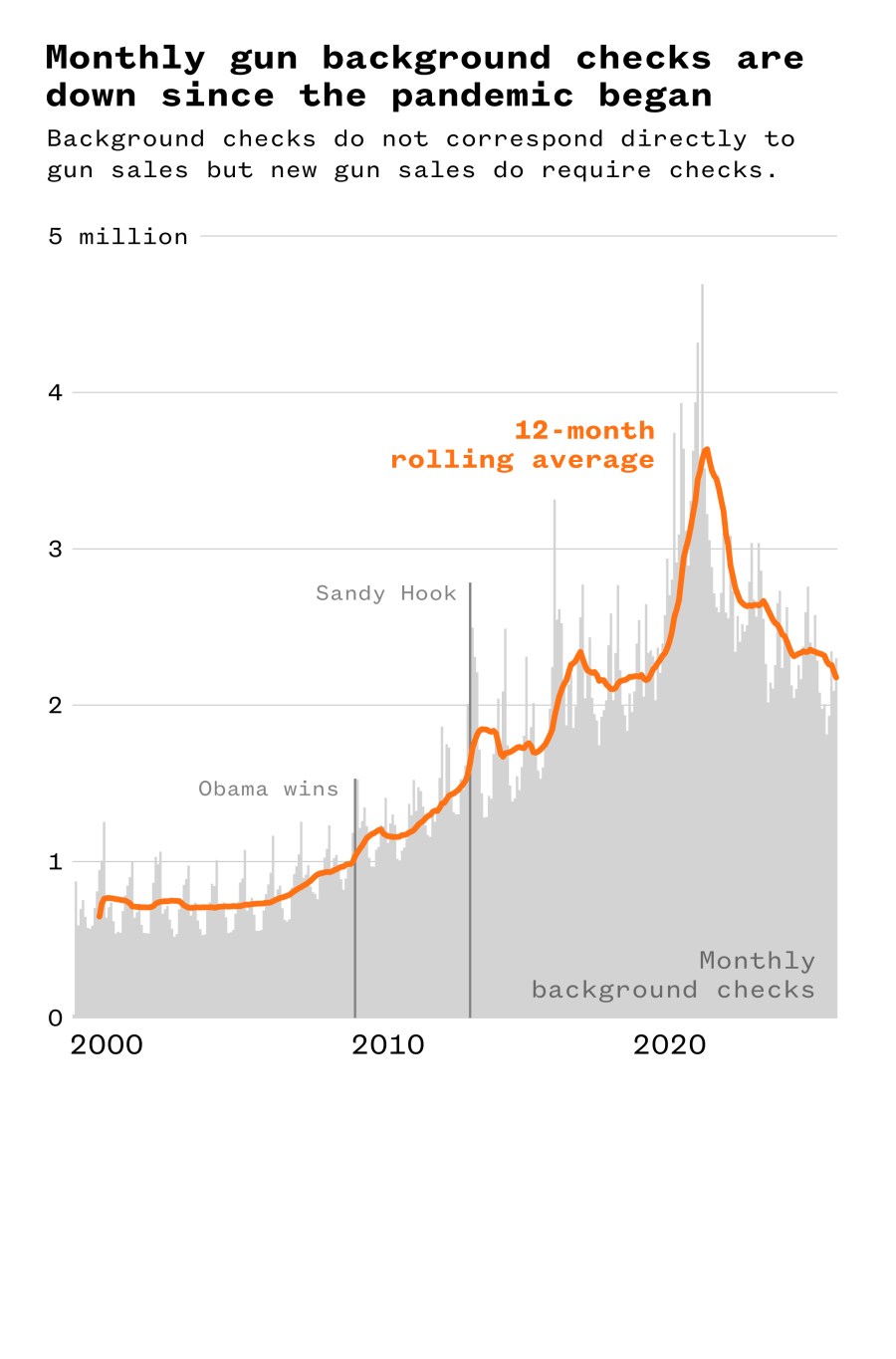
Since that peak, though, background checks have trended downward. This overlaps not only with the waning of the pandemic, but also the erosion of the NRA itself. LaPierre was accused of siphoning off NRA money for his own benefit, leading to a New York jury finding him liable for millions of dollars in penalties. The organization lost about a fifth of its membership between the emergence of the allegations against LaPierre in 2019 and 2022.
The federal government conducted an average of 2.2 million background checks per month in 2025, down from an average of 3.3 million a month in 2020 and about even with the 2018 average. It’s lower, though, than the 2.3 million average in 2016, the last year of Obama’s presidency.
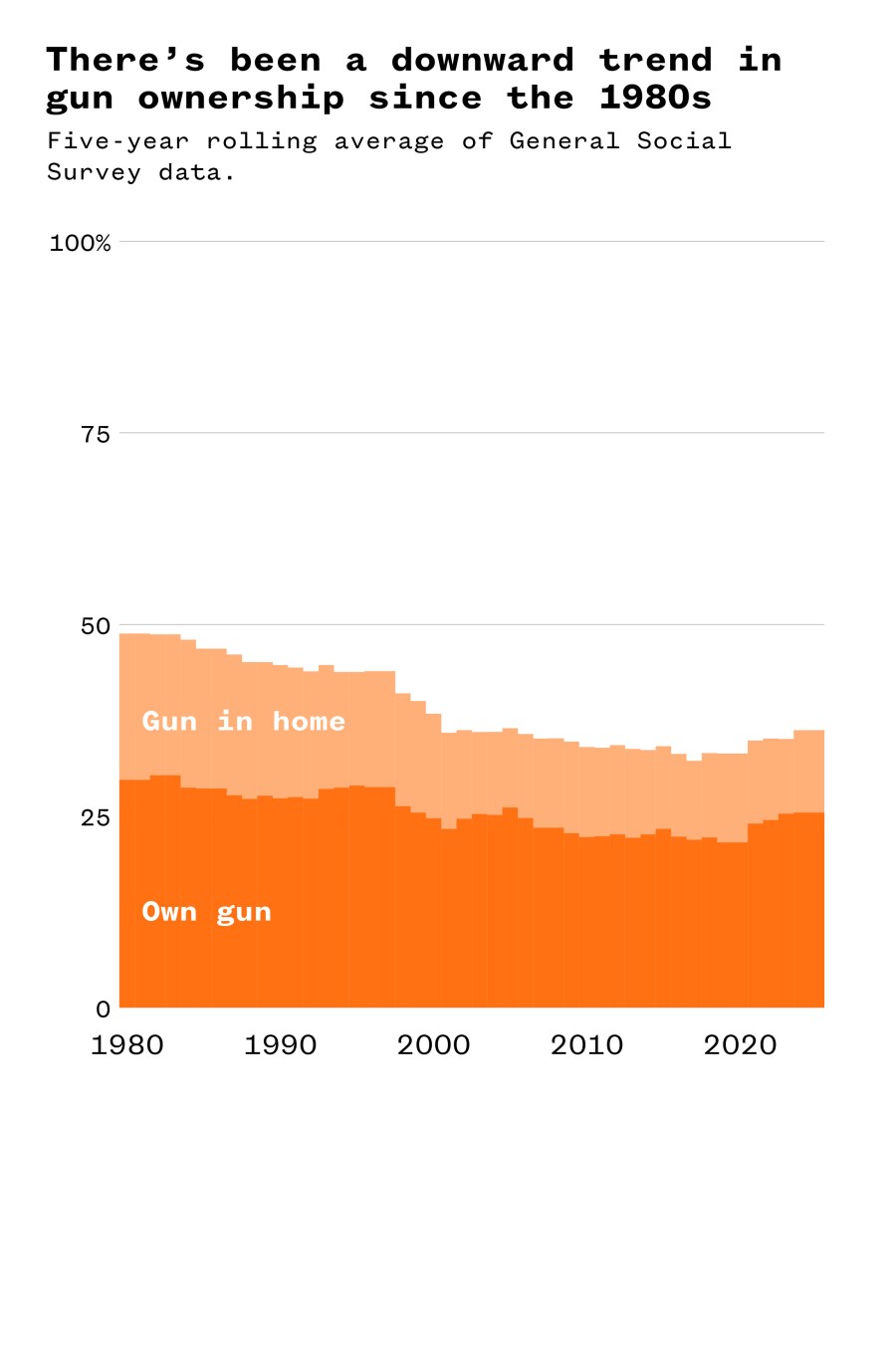
Again, this is an imperfect metric. When pollsters ask Americans whether they own guns, we typically learn that about 40% have guns in their households, often owned by other people in the home. There’s a reason that figure may be lower than you expect: Many new gun purchases are made by people who already own guns. There are a lot more guns in America than people, because a lot of people who own guns own several.
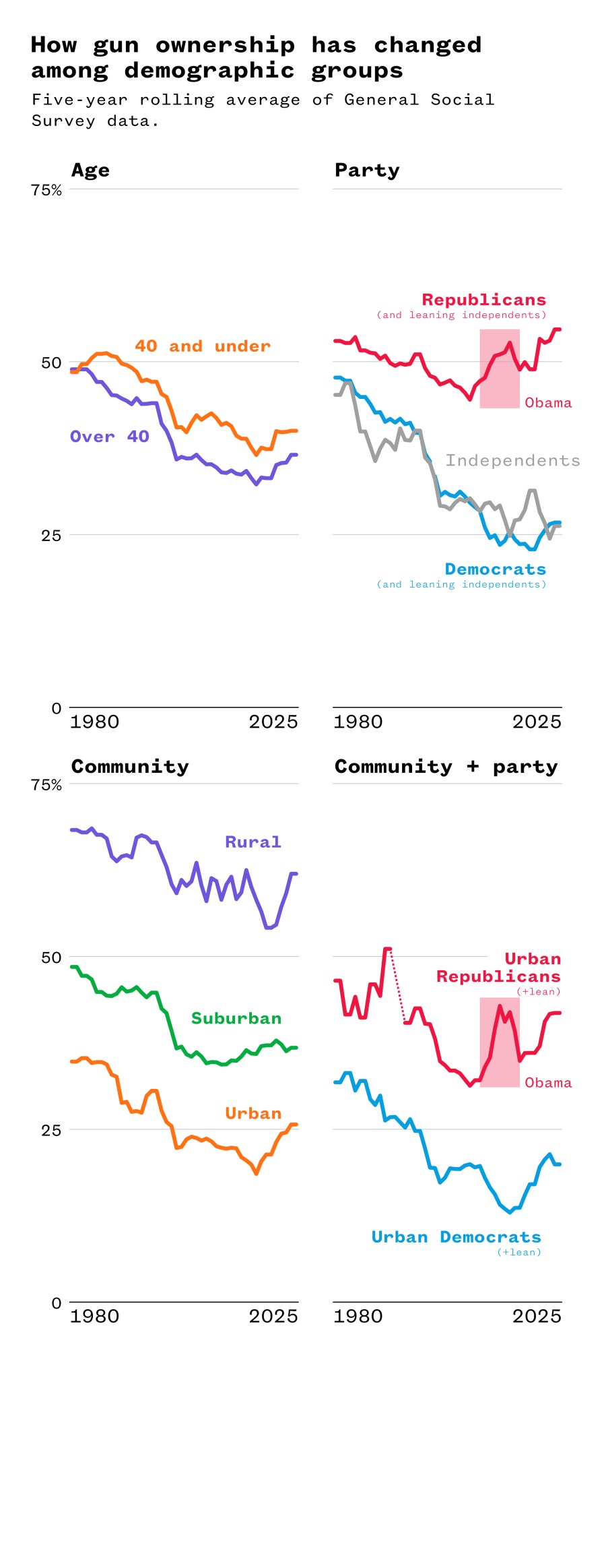
Even as background checks (and sales) rose two decades ago, the number of households with guns declined, according to polling conducted as part of the General Social Survey. Only when the pandemic arrived did it begin increasing again.
While rifles such as the AR-15 have gotten a lot of attention — due to how often they’re used in mass shootings — the General Social Survey indicates that the percentage of households with shotguns and rifles has contracted over the past 20 years. The percentage with handguns, though, has increased.
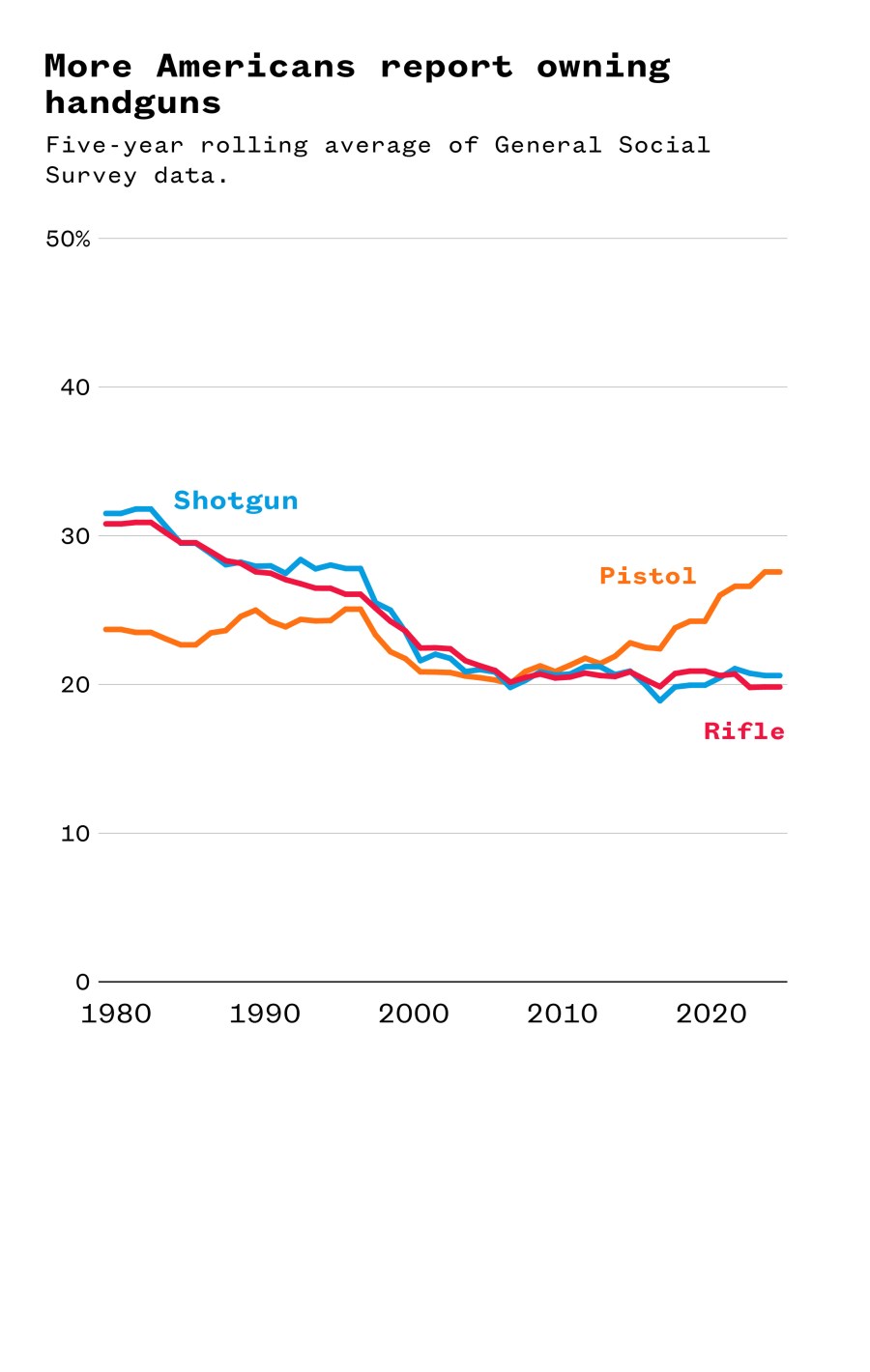
About a fifth of households reported owning at least two different types of firearms in 2024, the most recent year for which GSS data is available.
There are some demographic patterns in gun ownership that will likely not surprise you. Republicans and residents of rural communities — overlapping pools of Americans — are more likely to own firearms than are Democrats and city residents. You can see the effects of the Obama era in Republican gun ownership, with surges in ownership that correspond to the 2009 to 2017 period.
But one of the drivers of the increase in ownership in the months after the pandemic emerged was urban residents, including Democrats who live in cities. Urban Republicans were also more likely to own firearms after 2020, but they constituted only about a fifth of urban respondents in the 2024 GSS.
The Trace, a site that covers gun violence in America, analyzed the downturn in gun sales at the beginning of last year, and spoke with Vanderbilt University’s Jonathan Metzl, who raised a useful point.
“Many more people have guns now” than they did in 2020, he said, “and so the market of potential consumers is a lot smaller than it was during the pandemic.”
In other words, fewer gun sales doesn’t necessarily mean fewer guns. It may simply mean less demand.
The background check data suggests that the conditions for less demand continued through 2025: a president who was unlikely to endorse new restrictions on ownership, a hobbled NRA, the lack of a national crisis that might spur gun sales.
Is it possible we have moved past a historic peak in American gun culture? Maybe — but the conditions that exist now may not last forever.
Trump’s comments in the wake of Pretti’s death reinforce that this pattern is itself not necessarily stable. Trump did impose one new firearm restriction during his first term; the Supreme Court later threw it out. Without a significant counterweight, it’s not inconceivable that he might explore other restrictions in the future.
Take Trump’s comments about Pretti being armed. Agents working for Trump’s government, and at the direction of his appointees, shot and killed someone who objected to his administration’s policies. In that context, Trump expressed opposition to Pretti’s gun ownership — when the owner was an opponent of the government.
The interpretation of the Second Amendment that has driven conservative politics for decades is that it is necessary in order to hold government oppression at bay. But now a putatively conservative president suggests that gun rights don’t extend to his political opponents.
As for a crisis? Well, the events that led to Pretti’s death and the arrests of hundreds of others in major American cities suggest that such a disruption — one in which people look for protection against the government — may itself not be that far away. We may have seen a peak — or we might just be in a lull.