When Trump administration officials first started talking about the creation of an international panel to help oversee the peace process in Gaza, there was no reason to reflexively reject the idea. On the contrary, at a superficial level, this seemed entirely sensible and perhaps even necessary.
But as is always the case, the details would reflect the panel’s merits. With this in mind, The Associated Press reported on the unveiling of the entity known as the Board of Peace:
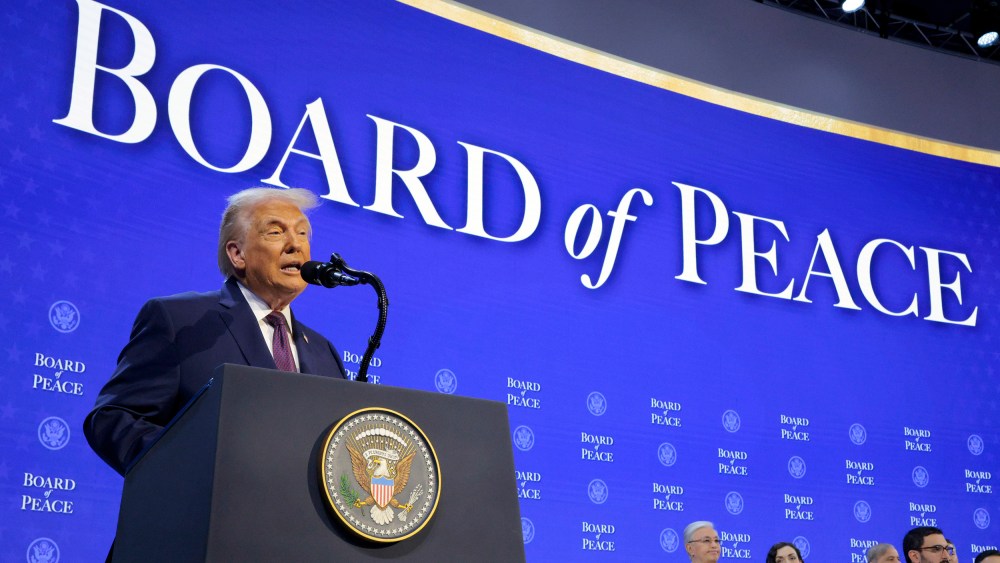
President Donald Trump on Thursday inaugurated his Board of Peace to lead efforts at maintaining a ceasefire in Israel’s war with Hamas, insisting that ‘everyone wants to be a part’ of the body he said could eventually rival the United Nations — despite many U.S. allies opting not to participate.
In a speech at the World Economic Forum, Trump sought to create momentum for a project to map out a future of the war-torn Gaza Strip.
Right off the bat, the American president’s boasts about “everyone” expressing an interest in joining the board is more wishful thinking than an accurate summary of global support. Several prominent U.S. allies — including the United Kingdom, Canada, Ireland, France, Ukraine, Norway and Sweden — have already declined invitations to participate, at least for now.
The White House had originally said that Belgium had signed on to the board’s charter, but its deputy prime minister soon after issued a statement explaining that Belgium was not a part of the entity.
Several repressive and autocratic governments have agreed to participate, though that doesn’t exactly extend the kind of legitimacy the White House was likely looking for. (For his part, Trump said this week that “controversial people … are people that get the job done.” He didn’t elaborate as to what that meant in this context.)
What’s more, it’s worth emphasizing that Congress played no role whatsoever in authorizing the creation of this international entity, which, by the president’s own admission, the White House sees as a potential replacement for the United Nations. Indeed, while the original plan appeared focused on Gaza, The Washington Post reported that the body “was presented Thursday by senior Trump administration officials as a vehicle for broader ambitions.”
But as the board moves forward, arguably the most important element is the degree to which it resembles the latest in a series of presidential power grabs. The New York Times reported, “In the proposed charter of the ‘Board of Peace’ that the United States sent to national capitals in recent weeks, one man has the power to veto decisions, approve the agenda, invite members, dissolve the board entirely and designate his own successor.”
The man, of course, is Trump — who, as The Wall Street Journal reported, would be positioned to lead the board “in perpetuity,” even after leaving the White House.
As for the finances, the draft charter for the board calls for $1 billion contributions from countries that want to participate for more than three years. Administration officials told the Times that the board “will implement the highest financial controls and oversight mechanisms” for the cash it collects and that “funds will sit only in approved accounts at reputable banks.”
Left unsaid is who, exactly, will be responsible for administering and allocating the collected funds, though in context, it seems likely that Trump will expect to maintain control.
Finally, there’s the board’s logo, which looks similar to the United Nations’ logo, except this one emphasizes North America — and like everything else associated with the incumbent Republican president, it’s gold.
Watch this space.