You cannot trust the Department of Homeland Security.
This seems like a political statement, but it isn’t. It is a recommendation rooted in 12 months of presentations and claims from Homeland Security officials and agents — claims that have been proven false at a remarkable rate.
It began early in President Donald Trump’s second term. When Homeland Security agents began conducting stops with their faces covered, the department insisted that their own safety required it. DHS officials regularly amplified claims about huge surges in assaults on officers — a breathless “690% increase” turned out to be a year-over-year increase from only 10 to 79 — but failed to show instances when those assaults followed from agents being identified. When I tried in vain to validate the numbers with public reports or criminal complaints, I found that many of the recorded assaults occurred at Immigration and Customs Enforcement detention facilities.
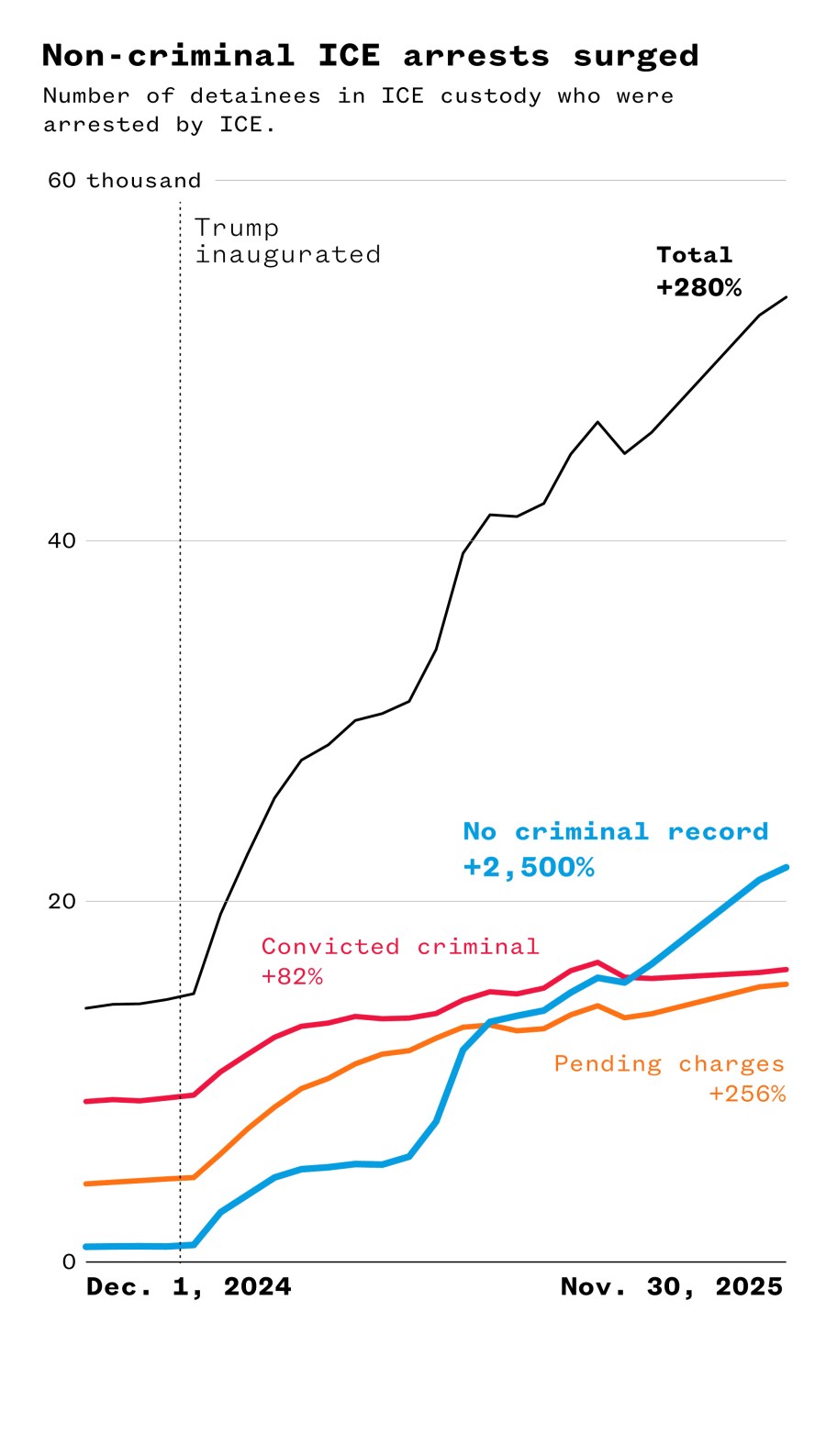
DHS and the administration have repeatedly said that agents were fanning out across the country to detain immigrants who’d committed crimes. (Vice President JD Vance made this claim on Thursday, in fact.) As 2025 unfolded, though, we learned that immigrants with no criminal record made up more ICE arrests than immigrants with criminal convictions. The number of detainees arrested by ICE without convictions or pending criminal charges rose from 842 on Dec. 1, 2024, to 21,892 on Nov. 30, 2025 — an astounding 2,500% increase.
When the Cato Institute’s David Bier used data from DHS to report that only 5% of ICE detainees have convictions for violent crimes, DHS Assistant Secretary Tricia McLaughlin declared on social media that the pie chart he used to present the analysis was “made up,” with “no legitimate data behind it.” When Bier shared the DHS document from which the data came, McLaughlin didn’t reply.
This is not an exception for McLaughlin. In October, she dismissed a viral video of a teenager, a U.S. citizen, being tackled by ICE officers in Chicago as having been taken in the prior year somewhere other than Chicago and at the hands of some agency other than ICE. None of this was true. That same month, she said in a statement that “ICE does NOT arrest or deport U.S. citizens.” When ProPublica later reported that more than 170 citizens had been detained by immigration agents, McLaughlin amended her comments to say that ICE didn’t “arrest U.S. citizens for immigration enforcement.”
On Thursday, ICE released Dulce Consuelo Diaz Morales after 25 days in detention following her arrest during an immigration enforcement operation. Her lawyers presented the government with evidence indicating that Diaz Morales is a U.S. citizen.
In November, the online news site Zeteo compiled a list of seven times McLaughlin had been caught making false claims (including the Chicago incident). But it couldn’t include McLaughlin’s assertions in the wake of the killing of Renee Good in Minneapolis this week. McLaughlin said on social media — even before Good’s identity was made public — that Good had “weaponized her vehicle, attempting to run over our law enforcement officers in an attempt to kill them — an act of domestic terrorism.”

Video evidence from the scene and analysis by multiple news outlets shows no evidence that this was true. But this was the DHS line from the outset, presented by DHS Secretary Kristi Noem at a press conference on Wednesday.
Noem, too, has made false claims before. For example, as the Trump administration sought to impugn Kilmar Abrego Garcia (apparently as a post hoc rationalization for deporting him to El Salvador in contravention of a judge’s order), the DHS secretary spread false claims about the Maryland resident. Noem described Garcia as “an MS-13 gang member, human trafficker, serial domestic abuser, and child predator.” Each of those claims was contested by objective analysis or was flatly wrong.
U.S. District Court Judge Sara Ellis summarized the credibility of Noem and DHS in a 233-page ruling issued in late November. After articulating several claims that DHS had presented in a lawsuit alleging the use of excessive force in Chicago, Ellis anticipated how the government would respond.
“While Defendants may argue that the Court identifies only minor inconsistencies,” Ellis wrote, “every minor inconsistency adds up, and at some point, it becomes difficult, if not impossible, to believe almost anything that Defendants represent.”

In fact, there’s an entire section of her ruling titled “Credibility,” in which she writes that “[a]fter reviewing all the evidence submitted to the Court and listening to the testimony elicited at the preliminary injunction hearing, during depositions, and in other court proceedings, the Court finds Defendants’ evidence simply not credible.”
She isolates another DHS official as “not credible”: Border Patrol head Greg Bovino. Bovino has been present at a number of DHS immigration actions, including in Illinois, and was deposed as part of the lawsuit.
Ellis documents multiple dishonesties in his testimony, even noting that “Bovino admitted in his deposition that he lied multiple times” about an incident in which he’d thrown tear gas at protesters.
“[A]fter reviewing all the evidence,” Ellis summarizes, “the Court finds that Defendants’ widespread misrepresentations call into question everything that Defendants say they are doing” in describing the actions they took in the state.
This clearly applies more broadly than Chicago, but there is one more incident from that city that is worth highlighting.

The government accused two people, Marimar Martinez and Anthony Ruiz, of attempting to ambush federal agents. DHS claimed that Martinez was armed and that she was struck by “defensive fire” from officers. Both were described by the agency as “domestic terrorists” — as was Renee Good.
The Justice Department eventually dropped the charges against Martinez and Ruiz. A permitted firearm holder, Martinez never took her gun out of her purse. Her attorney said that he’d seen footage indicating that DHS agents rammed her car, rather than her striking them.
The DHS official who relayed this story to the press? Tricia McLaughlin.
One might wonder why agents of the federal government would consistently misrepresent the actions of their agency and its employees. Some of it might be explained by their desire to show allegiance to their workforce. Some might be ascribed to errors or incomplete information. But we cannot assume that this is the sole motivation when the government agency at issue is part of the Trump administration.
The president has repeatedly demonstrated a willingness in the past decade to make false claims that impugn his opponents or celebrate his allies — or both. This approach has permeated the government, carried into individual agencies by the loyal allies he’s installed as their leaders.
What this means, though, is that the skepticism one ought to bring to any pronouncement of Trump should similarly be applied to those who work for and defend him. Particularly when — as in the case of the Department of Homeland Security — those officials have repeatedly been caught in fabrications of their own.