This week the New York judge presiding over the state murder case against Luigi Mangione, charged with the fatal shooting of UnitedHealthcare CEO Brian Thompson, dismissed the two top counts of the indictment: first-degree murder “in furtherance of an act of terrorism” and second-degree murder as a crime of terrorism. While Mangione’s defense team fought for the dismissal of all of Mangione’s murder charges, the judge preserved the single non-terrorism-related murder count: second-degree murder with intent to cause the death of another person.
The judge preserved the single non-terrorism-related murder count: second-degree murder with intent to cause the death of another person.
The news of the dismissal of the New York terrorism charges arrived just hours before the state of Utah announced charges against Tyler Robinson in the Sept. 10 killing of conservative activist Charlie Kirk at a public university rally. Notably, Robinson was charged by way of “information” rather than “indictment,” meaning that no grand jury of his peers made a determination as to the quality of the state’s evidence and that the attorney general of Utah had even wider latitude than most prosecutors in deciding the final charges.
New York and Utah law mirrors the federal terrorism statute, dictating that an “act dangerous to human life” intended to “intimidate or coerce a civilian population or government unit” can constitute terrorism. Though it is a common motive and a widely accepted corollary, ideological allegiance is not a legal element of a terroristic offense in either state.
A modern reading of domestic terrorism law squarely situates American slavery and lynching mobs within its definition. Yet before 9/11, which shifted the focus of domestic terrorism prosecutions toward racialized suspicion of American Muslims, bombings by anarchists and labor activists were the primary targets. Although public discourse and prosecutorial agencies have since begun to address historically rooted far-right white nationalist violence as domestic terrorism, the law has seldom been used to address a rampant act here at home: mass shootings.

It is often the path of least resistance — and more deeply rooted in legal precedent — to charge these people with murder or hate crimes, especially for state-level prosecutions. The teenager who opened fire on his school in Oxford, Michigan, in 2022 is one of the only mass shooters to be charged under terrorism law, an example made that much more distinct by the fact that political ideology was not ostensibly the motive. Like Mangione’s case, the Oxford shooting was also a rarity as a state, rather than federal, terrorism prosecution.
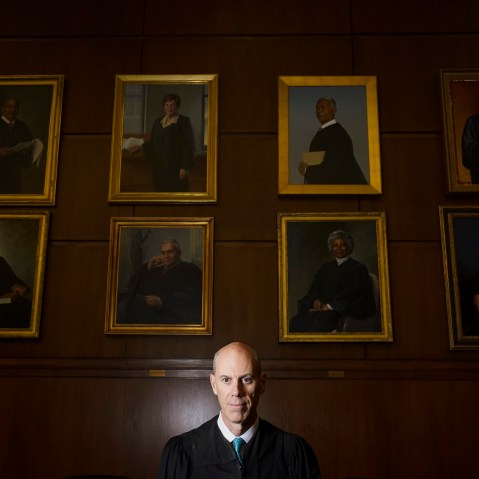
Federal and state prosecutors have sweeping discretion in deciding what charges to file against a criminal defendant; however, the decision ultimately lies with a judge as to whether there is legal basis for such charges to proceed to a jury trial. In his ruling, Mangione’s judge rejected the state of New York’s argument that the employees of UnitedHealthcare constituted a “civilian population” under law. Citing case law, the judge determined that a “civilian population” should be treated as inhabitants of a particular area (i.e., those in proximity to the violence) and that UnitedHealthcare was too remote and abstract a party. If Mangione had opened fire amid a conference of UnitedHealthcare employees, the judge’s decision may likely have differed.
Now make no mistake: The murder of any human being is a heinous criminal act. But as with Mangione, prosecuting individual actors for terrorism against other individual actors dilutes the purpose of this body of law, which is intended to address terrorism affecting the public or our sacred systems of government (there is a substantive argument to be made under terrorism law about Jan. 6).
Had Mangione’s judge elected to keep the terrorism charges against him, it might have paved the way for prosecutors in Robinson’s case, and others like it, to include terrorism charges as a matter of course.
Despite their tenuous legal argument, which hinged solely on creative wordsmithing, Mangione’s prosecutors “upcharged” him with terrorism as a case study, seeking to expand their charging capacity under terrorism law to all actors who kill with political agendas. If the charge had stuck and the trial judge’s decision was affirmed by higher state courts, this logic may have opened the door nationwide for an onslaught of new terrorism charges, with courts in other states citing the Mangione case as a persuasive (and uniquely high-profile) authority.
In Robinson’s case, the state of Utah had a much stronger argument that the killing of Kirk at a public rally was intended to intimidate members of Turning Point USA, Kirk’s right-wing organization, and others in attendance. Yet despite acknowledging the risk of harm to others as an “aggravating factor” that made Robinson eligible for the death penalty, no terrorism charge was filed. There is no indication that Mangione’s dismissals chilled any ambitions of Utah prosecutors to bring terrorism charges or that such charges were even considered. However, had Mangione’s judge elected to keep the terrorism charges against him, it might have paved the way for prosecutors in Robinson’s case, and others like it, to include terrorism charges as a matter of course.
How we choose to categorize and criminally charge politically violent acts is hardly semantic. In Mangione’s case, preserving the terrorism charges boosted the “degree” of murder into the first-degree range and would have enhanced his sentencing exposure if were convicted. It also would have validated a governmental agency’s pushing the limits of its already-expansive prosecutorial discretion in pursuit of a conviction, a dangerous precedent for all types of criminal cases.
Federal (and the vast majority of state) law is clear: A act of violence motivated by political ideology is not inherently an act of domestic terrorism. No one, no matter what they have done, deserves to serve a single day in prison for a crime they did not commit. We do not get to cherry-pick who is entitled to this central constitutional principle, and it does not apply only to those innocent of all criminal behavior. Mangione very well may become a convicted murderer, but in light of the judge’s ruling, he will not under law be deemed a terrorist.