




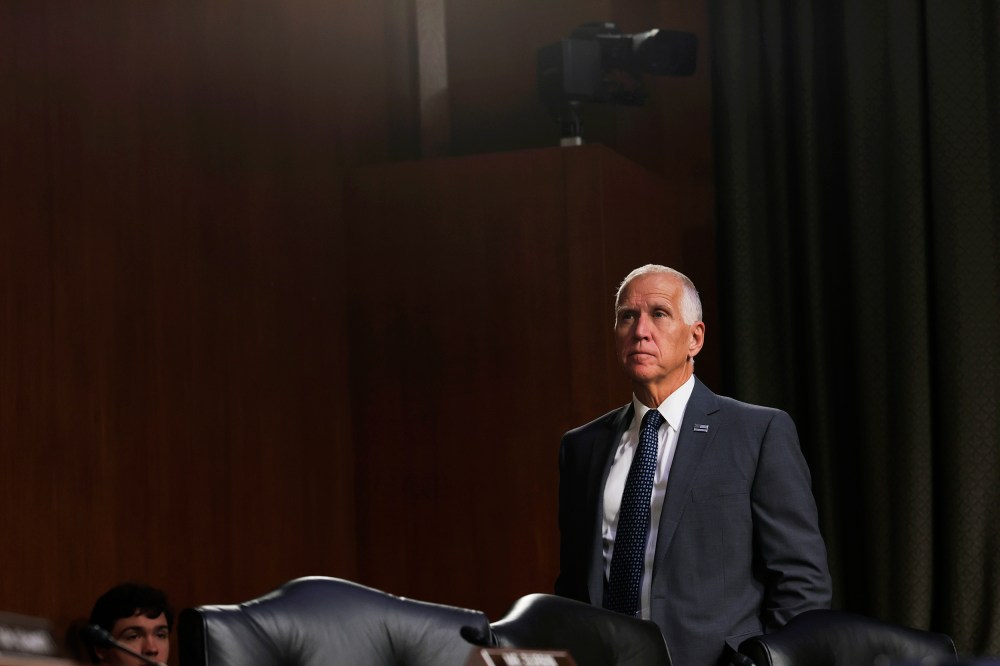
Sen. Thom Tillis isn’t on North Carolina ballots this year. But his shadow still looms over the state’s Senate race — and is shaping how both parties are approaching a pivotal general election for control of the chamber.
Voters in the Tar Heel State head to the polls on Tuesday to select their nominees for November’s race to succeed Tillis, who sent shock waves through Raleigh and Washington last year when, after a blistering showdown with President Donald Trump, he announced he wouldn’t run for a third term.
His departure made for a high-stakes race in a key battleground state: The seat is a top pickup opportunity for Senate Democrats as they try to claw back into the majority, and a locale Republicans will have to defend to keep control of the chamber.
Follow MS NOW’s midterm elections live blog for the latest updates and analysis on today’s biggest races across Texas, North Carolina and Arkansas.
The results of the primaries on Tuesday won’t be a surprise: Michael Whatley, the Trump-endorsed ex-chair of the Republican National Committee, is on a glide path to the GOP nomination, while former Democratic North Carolina Gov. Roy Cooper is running unopposed.
But the unfolding primary race — and looming general election — underscore an emerging theme: Republicans are betting on MAGA being the answer to their North Carolina quandary, and Democrats are just fine with that.
“That’s part of it,” Sen. Ted Budd, R-N.C., told MS NOW, before quickly pivoting to Whatley’s other attributes.
Tillis has a different view of how to win in North Carolina.
“I guess the Republicans who would want a purity test would want to decide whether or not they want to be right and have a Democrat elected a senator,” Tillis told MS NOW. “At the end of the day, if you don’t — if your priority is making a party feel good about you that represents only 30% of all the voters in North Carolina — then you probably ought to study math.”
“You win statewide races by appealing to a majority of the unaffiliated voters,” he added. “You lose statewide races thinking all you have to do is be in good standing with the Republican Party.”
It’s a warning born of experience, and recent history. Tillis is a Republican who is willing to break from his party on key votes, criticize Trump on matters he disagrees with and work across the aisle to craft bipartisan legislation — characteristics that run counter to the MAGA movement, and that may have hastened his retirement.
Tillis revealed in June that he wouldn’t run for re-election this year, an announcement that came one day after he said he’d vote against the GOP’s marquee reconciliation package — a position that drew intense ire from Trump.
Hours after Tillis declared his opposition, Trump on Truth Social accused the North Carolina Republican of trying to “GRANDSTAND in order to get some publicity for himself, for a possible, but very difficult Re-Election”; said Tillis was “making a BIG MISTAKE for America, and the Wonderful People of North Carolina”; and warned that he would speak to potential primary candidates to find “someone who will properly” represent North Carolina.
The next day, Tillis said he was tapping out, citing the tribal politics in Washington.
“When people see independent thinking on the other side, they cheer,” Tillis wrote in a statement. “But when those very same people see independent thinking coming from their side, they scorn, ostracize, and even censure them.”
It was a reminder of a familiar dynamic in Washington: You’re either with Trump or he’s against you. Republicans in North Carolina are taking note.
Weeks after Tillis’ exit, Trump pre-emptively endorsed Whatley, whom he backed for RNC chair in early 2024 to oversee his third bid for the presidency. Whatley eventually jumped into the race, citing his strong Trump bona fides — and taking a veiled swipe at Tillis.
“I am honored that President Trump has asked me to run for the Senate and offered me his complete and total endorsement,” Whatley said in remarks launching his campaign. “And I am proud to stand with him and fight every single day for every family and every community.”
“President Trump deserves an ally, and North Carolina deserves a strong conservative voice in the Senate,” he continued. “I will be that voice.”
Both parties are making Tillis’ split with Trump a central theme of the race.
Former U.S. Navy Judge Advocate General officer and author Don Brown, who’s running for the GOP nomination, accused Whatley of trying to protect Tillis, arguing that he can’t be aligned with both Trump and the North Carolina Republican.
“If Michael Whatley truly stands with President Trump, why does he stay silent every time Thom Tillis undermines him?” he wrote on Facebook. “You can’t serve Trump voters and protect Thom Tillis at the same time. Trump or Tillis? You can’t have both. North Carolina Republicans deserve clarity — not silence.”
In another post that same month, Brown lambasted Whatley as Tillis’ “buddy and clone.”
While the attacks are unlikely to affect the primary — a poll conducted by The Carolina Journal last month had Whatley leading his five opponents by roughly 30% — they underscore the lens by which Republicans are viewing the race: Ties to Tillis are negative, connections to Trump are positive.
Democrats, meanwhile, are leaning into the dynamic, but from the other direction: Their messaging suggests they see the Trump-aligned candidate as beatable in a general election.
In January, the North Carolina Democratic Party compared Whatley’s silence on the fatal shooting of Alex Pretti in Minneapolis to Tillis’ swift call for an investigation into the death.
“As Republicans Thom Tillis and Ted Budd call for an investigation into the death of an American citizen, Michael Whatley’s complete silence is deafening,” North Carolina Democratic Party spokesperson Mallory Payne said in a statement. “It’s been five days — where does Whatley stand and what is taking him so long to say it? Whatley continues to prove he will never be an independent voice who stands up for North Carolinians.”
The messaging is an early window into how Democrats are viewing the general election, which will be a close battle that has massive implications for the control of the Senate. While Trump won North Carolina the past three cycles, Cooper, a Democrat, also won statewide in 2016 and 2020, despite Trump’s victories on the same ballot.
Recent polls show Cooper with a healthy lead over Whatley.
As the primary season comes to an end, Tillis is brushing off the attention he’s getting on the campaign trail as he watches from the sidelines. Asked by MS NOW about his name being invoked, the North Carolina Republican, who has served in elected office since 2007, chalked it up to politics as usual.
“It’s the same old, same old, you know,” Tillis said. “That’s just the way politics are. Like I’ve told the Republican — what a lot of the Republicans who are constantly attacking other people have in common is they’ve never won a race and they don’t know how to govern.”

Mychael Schnell is a reporter for MS NOW.