




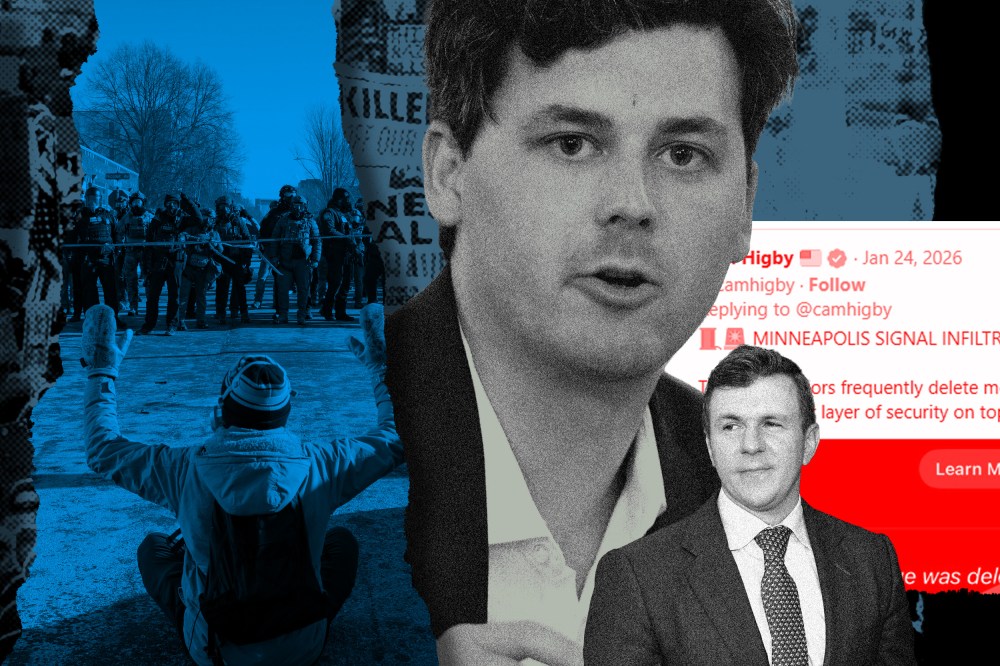
Over the weekend on X, conservative influencer Cameron Higby began posting screen recordings from the encrypted messaging app Signal showing a list of hundreds of usernames in one massive group chat in Minnesota. He posted the video alongside a red-siren emoji and a message to more than 300,000 followers, concerning U.S. Immigration and Customs Enforcement operations: Higby had “infiltrated” the Minneapolis resistance.
MS NOW has not verified the Signal channels. But this kind of community group chat has become common in Chicago, Los Angeles and Minneapolis, where neighbors and activists are using the apps to organize and monitor ICE operations amid President Donald Trump’s federal crackdowns.
For Higby, the chat was evidence of something more. He dubbed the operation “Signal Gate” and presented the chats as evidence that “Minnesota insurrectionists” were coordinating to “hunt” ICE agents, to impede and assault them and to obstruct their enforcement of immigration laws. He called for a congressional investigation into the community activists and their chats. None of the chats Higby posted included plans or calls for obstruction or violence.
His posts spread on conservative media, racking up tens of millions of views while fueling a White House narrative that federal immigration officers in Minneapolis were facing a violent uprising by mobs of “domestic terrorists.” Online crowds began combing through the leaked chats, attempting to identify participants and alleging without evidence that local elected officials were involved. FBI Director Kash Patel on Monday confirmed that the Trump administration was paying attention.
“As soon as Higby put that post out, I opened an investigation,” Patel told podcast host Benny Johnson.
Two narratives are competing in Minneapolis.
One, documented by bystanders, journalists, courts and city and state officials, holds that this community has been overtaken by thousands of federal agents — a masked, violent force that has ripped neighbors from their cars, homes, workplaces and schools, and beaten, jailed and disappeared them. Members of the community who organized to document federal agents’ movements or protest their presence have been met with aggression and violence, including the fatal shootings of American citizens Renee Good and Alex Pretti — killings that sparked national outrage.
The other narrative casts protesters and organized observers as “domestic terrorists” who threaten and impede federal law enforcement. Online influencers like Higby play a central role in amplifying, and in many cases producing, propaganda for that framing. And this is the narrative that the Trump administration has run with, even when video evidence disputes it.
Higby is part of a loose network of reactionary conservative content creators who style themselves journalists and claim to document rampant left-wing violence. In October, the White House hosted an antifa roundtable event — attended by Higby and other influencers with ties to Turning Point USA and its media arm, Frontlines — where these influencers reinforced the narrative that far-left extremists were mobilizing a nationwide campaign of violence against ICE agents.
The work of these creators blurs journalism with political activism: It focuses on discrediting leftist protest movements, amplifying misleading narratives and promoting content creators into celebrities across conservative media, where they’re presented as both victims and truth-telling heroes.
Their presence at demonstrations has repeatedly coincided with heightened tensions and physical altercations. The confrontations are then cited as evidence that the protests are inherently violent, and justify a harsher government response — most recently, demands from far-right influencers that Trump invoke the Insurrection Act in Minnesota.
Despite Higby’s claims about the Minneapolis community, the Signal chats revealed little that wasn’t already known. Reporting on the ground, including by MS NOW, has documented the way ICE observers communicate on encrypted messaging apps (the same ones used by journalists, privacy advocates and community organizers) and coordinate by sharing locations, alerting neighbors to the presence of federal officers and filming arrests.
Documents Higby shared from the Signal chats also undercut his most explosive claims.
One recording, which he described as a scroll through a “training manual for domestic terrorist patrols,” is a guide for monitoring federal law enforcement operations. Its contents include a primer on alerting bystanders to ICE’s presence, using whistles, car horns and video recordings. It also warns participants not to text while driving, suggesting language to use when confronted by officers (such as “I am not impeding”) and emphasizing that participants should carry themselves as “neighbors protecting neighbors,” not law enforcement or a militia.
“We are witnesses, not warriors,” it reads.
Higby defended his reporting in a phone call with MS NOW. He argued that the Signal chats — in which he found no calls for violence or evidence of its intent — were used to track ICE agents’ movements and summon observers, which in his view (and in ICE’s view) amounts to impeding federal law enforcement.
Higby described himself as both a journalist and a political commentator. He said that being open about his conservative bias makes him an ethical journalist.
“As journalists, everyone has a bias,” Higby said. He characterized his calls for Trump to deploy the National Guard or invoke the Insurrection Act as “commentary.”
The information war unfolding in Minneapolis is not new. The second Trump administration has relied on loyal online creators to shape and distribute its message, sidelining legacy media in favor of partisan influencers and political operatives.
In fact, it was a rising right-wing influencer who beckoned the federal government to Minneapolis.
Nick Shirley, a 23-year-old YouTuber who once chased virality through Jake Paul-style stunts, found his following (currently 1.6 million YouTube subscribers) with man-on-the-street videos aimed at a MAGA audience. In December, Shirley — now calling himself an investigative journalist — teamed up with a local lobbyist and, using information reportedly obtained with the help of Minnesota Republicans, produced a 43-minute video in which he knocked on day care doors, demanded to see children and said he had exposed a billion-dollar child care fraud scheme involving Gov. Tim Walz and Minnesota’s Somali community.
Social services funding fraud in Minnesota has been the regular subject of mainstream news reports and federal investigation since 2022. But Shirley’s video —fanciful and thin on new evidence — was viewed millions of times and struck a chord in the audience for which it was intended.
“This dude has done far more useful journalism than any of the winners of the 2024 @pulitzercenter prizes,” Vice President JD Vance posted on X.
A surge in federal officers and officials from the Department of Homeland Security and the FBI followed.
Right-wing influencer Nick Sortor, a former Kentucky real estate agent with 1.4 million followers on X, arrived in Minneapolis at about the same time. Much of his most popular content centers on confrontations with people on the street or at protests — clips that go viral and become talking points on conservative prime-time shows. In a video from earlier this month, Sortor’s white Jeep is surrounded by a small crowd outside a detention center near Minneapolis. Protesters slap the windows and shout threats at Sortor and his passenger, Higby, as the vehicle inches forward. When Sortor accelerates, a man who had climbed onto the hood falls off. On Fox News, Sortor framed the incident as a near-death escape from rioters. He called the city “lawless” and “a total loss,” and urged Trump to invoke the Insurrection Act.
Another video, posted by local livestreamer Andrew Mercado, shows Sortor’s interactions with demonstrators in the moments before he got in the Jeep: While standing among a few dozen protestors, a woman blocks Sortor’s camera by holding up an object. Sortor yanks it from her hand and attempts to pull off her face mask as she strikes at him.
Before his time in Minneapolis, Sortor was engaged in a similar brand of punditry in Portland, Oregon, where, on multiple occasions last year, he got into physical altercations with protesters. Trump, Patel and Attorney General Pam Bondi praised Sortor at the antifa roundtable event as an independent journalist. In the same breath, they lauded his actions at a December protest, where he was captured on video grabbing a burning flag from an elderly protester. State disorderly conduct charges filed against him were later dropped.
Sortor, who has claimed online that he continues to speak to Bondi and maintains a direct line with the federal government, did not respond to a request for comment.
“This is their profession,” said Joan Donovan, an assistant professor of journalism at Boston University who studies media manipulation. She noted that the creators often center themselves as protagonists.
“They gin up outrage, film it and then use that content to recruit followers, get paid on social platforms or convert it into political currency that gets them closer to power,” Donovan said. “Are they a political activist or a clout-chasing influencer, or are they there to report the facts?”
On Tuesday, James O’Keefe, a self-styled undercover journalist known for his group’s deceptive stings and edited videos, said he’d been chased out of a Minneapolis suburb.
“I’m shaken,” O’Keefe told podcaster Megyn Kelly, describing an encounter with five white women who he said demanded his press credentials. Video posted by O’Keefe shows him rushing to his car while a crowd chants “shame.” A bottle of water bounces off the car as it pulls away.
“These people will kill you. I’ve never quite experienced, I guess I would call it communism, up close,” O’Keefe told Kelly. O’Keefe did not respond to a request over Signal for comment.
For all the content being produced by these creators, its power has limits. Trump has not yet invoked the Insurrection Act. Instead, public outrage over the killings of Good and Pretti — two Minneapolis residents, a mother and an intensive care nurse, respectively, both described by friends, family and neighbors as kind and community-minded — has only swelled, along with criticism of the federal response. On Monday, Border Patrol official Gregory Bovino was removed from his post as “commander at large,” a move widely interpreted as a Trump administration attempt to de-escalate tensions in the state.
But influencers who have pushed the Minneapolis community insurrection narrative are forging ahead. Sortor, who appears to be the first to report Bovino’s ouster, condemned the move as a capitulation, and urged his followers: “DO NOT BACK DOWN!”

Brandy Zadrozny is a senior enterprise reporter for MS NOW. She was a previously a senior enterprise reporter for NBC News, based in New York.