





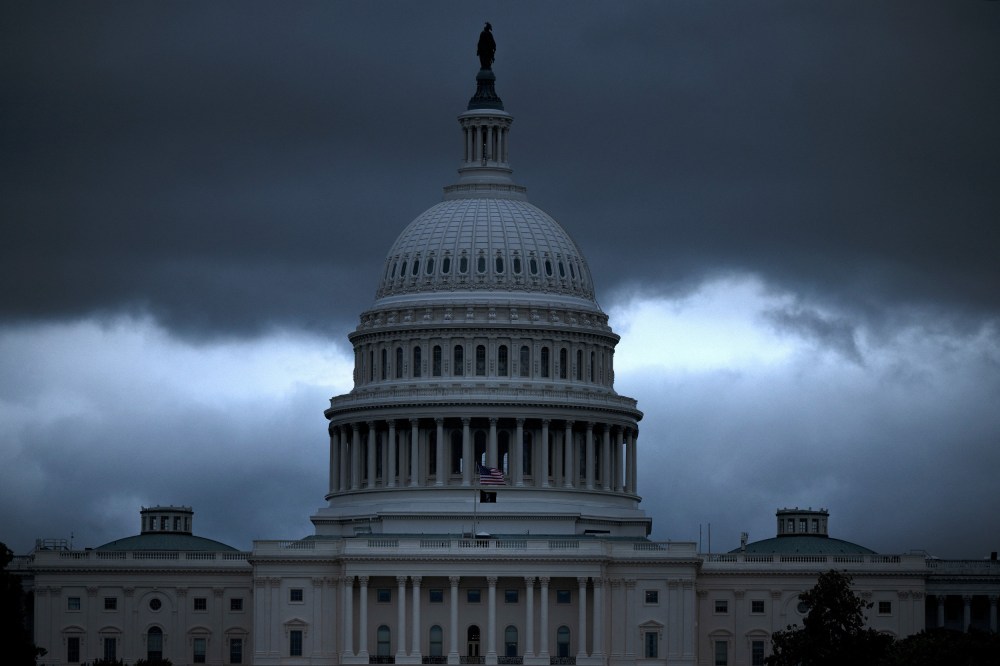
The Department of Homeland Security is now officially — technically — in a shutdown, marking the third funding lapse of President Donald Trump’s second term.
Solving this one could take a while.
After two weeks of negotiations between Democrats and Republicans across Pennsylvania Avenue, lawmakers left Washington on Thursday without a deal to fund the sprawling department, all but ensuring the lights would turn off at the week’s end.
Now, with both parties digging in on changes to the controversial Immigration and Customs Enforcement agency, it’s anyone’s guess when the lights will come back on.

Congressional Democrats and the White House have traded proposals — with another expected in the coming days — but the exchanges have produced few agreements, prompting the White House to direct DHS to shut operations down in a document sent to the agency late Friday afternoon..
A big part of the problem is that Democrats see little incentive for funding DHS. The DHS funding bill covers roughly 4% of federal agency spending, and while many of the agencies that could be affected by a funding lapse are the ones that Democrats support, approving any new funding for the agencies where Democrats want reforms has become politically toxic.
Those more controversial agencies — like ICE and Customs and Border Protection — are set to continue operations despite the shutdown. (ICE and CBP received billions of dollars from the GOP’s reconciliation bill over the summer, leaving them awash in cash for the time being and taking away some of the urgency driving negotiations.)
Meanwhile, those agencies Democrats largely support — like the Coast Guard, the Secret Service, the Transportation Security Administration, the Federal Emergency Management Agency, and the Cybersecurity and Infrastructure Security Agency — are most at risk of feeling the effects of a shutdown.
Heading into the weekend, a deal to fund the agencies through the fiscal year, which ends in September, remains elusive.
“I know what they want. I know what they can live with. The Democrats have gone crazy,” Trump said at the White House on Friday. “They’re radical left lunatics. That’s why their cities are so unsafe. The blue cities are the cities that are unsafe. So we have to protect our law enforcement.”
House Minority Leader Hakeem Jeffries, D-N.Y., fired back on Friday, castigating the White House’s offer as “unserious.”
“The reason why we’re confronting the possibility of a shutdown in a few hours is because Republicans are unwilling to enact change that is dramatic,” Jeffries told reporters. “We believe any changes should be bold, should be meaningful, should be dramatic, should be transformational, should get ICE completely and totally under control.”
Jeffries said he expects House and Senate Democrats to “jointly” respond to the White House’s proposal, declining to offer details on timing or substance other than to say the party is “working feverishly.”
It will be the latest legislative ping-pong, after Senate Minority Leader Chuck Schumer, D-N.Y., kicked off negotiations by unveiling a list of 10 demands, including mandating officers to remove their masks and turn on the body cameras, requiring judicial warrants for entering private property, and establishing a use of force policy.
After the fatal shooting of Alex Pretti in Minneapolis at the hands of federal immigration agents last month, Democrats in both chambers said they would not support new funding for DHS without significant reforms to how ICE operates, thwarting what was on track to be a drama-free government funding exercise.

Republicans quickly panned the Democrats’ requests, especially the masks provision, which Democrats saw as an easy ask during the talks. Scores of GOP lawmakers — from moderates to hardliners — raised concerns about federal agents being doxxed, a sign of the treacherous terrain to come.
“They just put a laundry list out of impossible demands, and they knew it,” Sen. Shelley Moore Capito, R-W.Va., told MS NOW on Thursday.
The White House responded this week with an offer of their own, which both parties have refused to describe in full. Now, Democrats are prepping their latest entreaty.
“We still have a long ways to go,” Sen. Gary Peters, D-Mich, said Thursday, arguing that the White House’s proposal “doesn’t go far enough.”
Despite the headwinds, the White House says it’ll remain at the negotiating table. On Friday, Office of Management and Budget Director Russ Vought writing in a memo: “The Administration will continue to seek good-faith, bipartisan solutions to complete the appropriations process and avoid another damaging government shutdown.”
As lawmakers go back and forth on their proposals, the shutdown could stretch on for some time.
Neither the House, nor the Senate is due back until Feb. 23. And with the money from the reconciliation bill, there’s less urgency to solve this than normal for many agencies. On top of the $75 billion for ICE and the $65 billion for CBP, there’s also a $10 billion pot of money Republicans gave DHS “to safeguard the borders of the United States,” without any further restrictions.
Some of those funds were used during last year’s shutdown to keep paychecks going to CBP, ICE, the Secret Service, and the Air Marshals.
Vought referenced those funds Friday, writing in a memo: “immigration enforcement and border security operations have ample funding provided through the Working Families Tax Cut Act.”
But even in instances where an agency didn’t receive money from the reconciliation bill, there’s still some time before the shutdown is painful.
For example, TSA agents won’t exactly feel the impact of the shutdown immediately. Their next paycheck isn’t scheduled until Feb. 26, and even then, they’ll still get paid for this past week — though not the first week of the shutdown.
It won’t be until March 12 when TSA agents miss an entire paycheck, buying lawmakers some time before the pressure mounts.
Already, some Democrats are exploring an escape hatch.
Rep. Rosa DeLauro, D-Conn., introduced a bill to fund all of DHS except for ICE, CBP and Homeland Security Secretary Kristi Noem’s office.
“We can segment, get these people funded, work in a parallel track with ICE and CBP and come to a conclusion,” DeLauro told MS NOW.

Mychael Schnell is a reporter for MS NOW.

Jack Fitzpatrick covers Congress for MS NOW. He previously reported for Bloomberg Government, Morning Consult and National Journal. He has bachelor's and master's degrees from Arizona State University.