





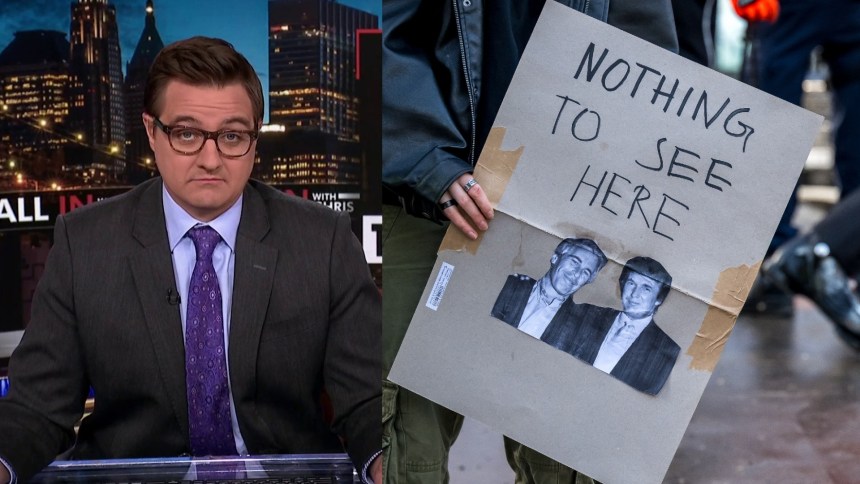
This is an adapted excerpt from the Feb. 25 episode of “All In with Chris Hayes.”
President Donald Trump gave the longest State of the Union address in history, speaking for nearly two hours on Tuesday evening. That is even more impressive when you consider that he did not have a lot of legislative victories to brag about.
That is normally how these things are supposed to go: You tout all of the bills you have signed into law and all of the wonderful things you have done. But Trump has overseen one of the least productive Congresses in U.S. history, even though his party controls both houses.
Trump’s Justice Department has fought the law at every turn, slow-rolling the release of the files, cherry-picking them for political effect and trying to put the Epstein story behind them.
During his address, the president only mentioned one bill: his budget-busting One Big Beautiful Bill Act, which slashed public services and gave more tax breaks to corporations and billionaires.
But he definitely neglected to mention one of the most consequential bills that he signed into law: the Epstein Files Transparency Act.
Perhaps Trump did not mention that bill because he did not want to pass it.
In fact, Speaker Mike Johnson shut down the House for months last summer and again in the fall to not deliver the votes to pass it. But then the whole thing was forced on Trump, against his will, by a near-unanimous vote of Congress.
However, once it was signed, the administration went out touting it. Attorney General Pam Bondi bragged that it released more than 3 million pages of documents and bragged that Trump was the “most transparent president in the nation’s history.”
Except that Trump’s Justice Department has fought the law at every turn, slow-rolling the release of the files, cherry-picking them for political effect and trying to put the Epstein story behind it.
Because we all know Trump and Jeffrey Epstein were close friends for many, many years. We have seen the photos of them together, the video from one of their parties in the ’90s and the birthday letter, which Trump denies writing to Epstein, that includes a gross drawing and the words “Enigmas never age” and “may every day be another wonderful secret.”
So every time the administration acts to cover up the Epstein files, it looks like it’s trying to keep a secret — and now we have probably the most suspicious evidence of that yet.
MS NOW, along with other outlets, has confirmed that the Trump Justice Department withheld some very specific Epstein files from the public, more than 50 pages of notes and memos related to interviews with a woman who accused the president of sexually abusing her when she was a minor.
The existence of those missing memos was first reported last week by independent journalist Roger Sollenberger, in a Substack post. He discovered that a released document that listed files in that case showed federal investigators had conducted not one but four interviews with Trump’s accuser in 2019, when he was president.
There were notes and summaries of each of those interviews in the FBI’s possession. But as Sollenberger found, and MS NOW confirmed, “only one memo — and no handwritten notes — reflecting such an interview is included on the DOJ [Epstein files] site.”
A source who has viewed the unredacted documents told MS NOW that the “woman interviewed by the FBI in July 2019 … is the same woman who alleged that Trump forced her to perform oral sex on him 35 years ago, when she was 13 or 14 years old, and subsequently hit her.” She also claimed she was repeatedly raped by Epstein.
According to the sole summary of her first interview that we do have, the one that was released, the woman’s lawyer told investigators that she “was concerned about implicating additional individuals [beyond Epstein], and specifically any that were well known, due to fear of retaliation.”
What did she tell them after that in three subsequent interviews? We don’t know, because those documents do not exist in the files that Trump’s Justice Department posted.
On Tuesday, the Justice Department responded in a social media post that “NOTHING has been deleted” and “ALL responsive documents have been produced.”
But that clearly seems false. As more outlets, including The New York Times, started reporting on the missing files, the Justice Department put out a new statement noting “that documents could have been withheld because of ‘an ongoing federal investigation.’”
“Could have been”? Or were? Or is that just a rationalization for not releasing the files that specifically pertain to the man who is in charge of the country?
Those allegations cannot be publicly verified as long as the Trump government withholds the files containing them.
That is not the only thing that did not make it into the Justice Department’s publicly released Epstein files.
The FBI also interviewed a woman known as “Jane” who testified under oath at the trial of Epstein’s accomplice, Ghislaine Maxwell. Jane claims she was introduced to Trump by Epstein at Mar-a-Lago when she was 14 years old.
MS NOW discovered that the handwritten notes from her interview are missing from the Justice Department’s website.
Trump has denied any wrongdoing, and all of those allegations are unverified.
As I have been saying all along, as these millions of documents come out, just because your name is in the files does not make you guilty of a crime. A lot of people’s names are in the files who have not been accused of anything.
But this much is clear, based on public reporting: A woman accused Trump of criminal wrongdoing in connection with his friend, a convicted child sex offender, and then she was interviewed by the FBI about what she says happened to her when she was 13 or 14. The files from those interviews were numbered and logged, but they have not been released to the public — and the Justice Department’s explanation for why that is keeps shifting.
So no, those allegations cannot be publicly verified — as long as the Trump government withholds the files containing them. It is entirely possible they may exonerate the president of any wrongdoing. But then, if they did, why wouldn’t his government want them released?
Allison Detzel contributed.

Chris Hayes hosts “All In with Chris Hayes” at 8 p.m. ET Tuesday through Friday on MS NOW. He is the editor-at-large at The Nation. A former fellow at Harvard University’s Edmond J. Safra Foundation Center for Ethics, Hayes was a Bernard Schwartz Fellow at the New America Foundation. His latest book is “The Sirens’ Call: How Attention Became the World’s Most Endangered Resource” (Penguin Press).