
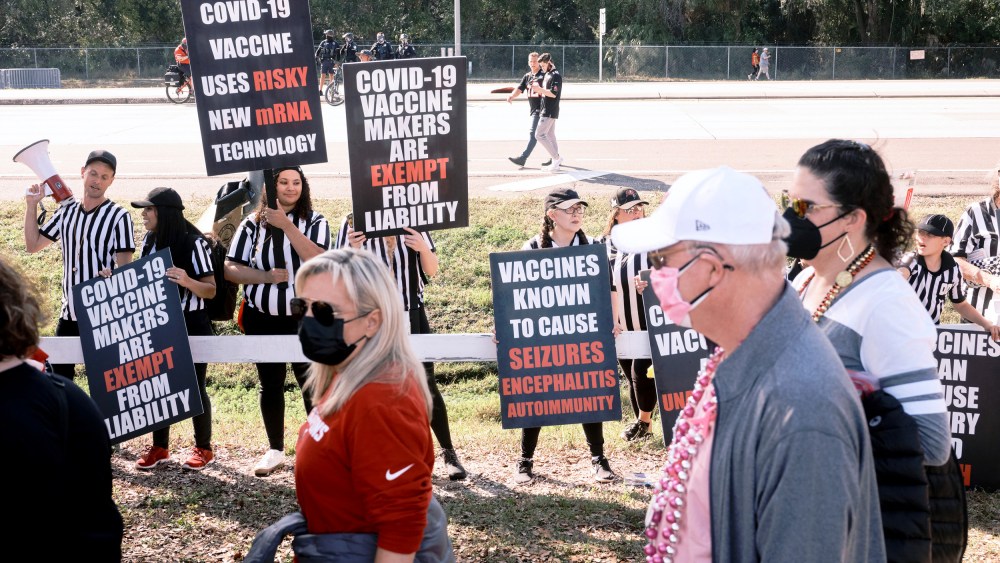
Twitter on Tuesday suspended Rep. Marjorie Taylor Greene from the platform for one week after the congresswoman tweeted that the Covid-19 vaccines are “failing,” a violation of the company’s “Covid-19 misleading information policy.”
We have allowed mandatory vaccinations in our country for more than one hundred years.
With misinformation like this coming from elected officials, it’s no wonder that the military and many workplaces and schools across the country are now mandating vaccines against Covid-19. One assertion that skeptics continue to circulate, and which Greene indicated in her tweet, is that “vaccine mandates and passports violate individual freedoms.”
Legally speaking, this is just not true. It is legal, under some circumstances, for the government and private businesses to require you to inject a substance into your body as a condition of entering a public space or being an employee. As recently as last week, a panel of federal judges allowed a vaccine mandate to go into effect.

Importantly, these federal rulings are not being made exclusively by liberal judges allowing the government to intrude further into our lives.
The conservative appellate judge who authored the opinion declining Indiana University students’ request to put that school’s vaccine mandate on hold is a solid example here. Indiana University decided to require that its students obtain a Covid-19 vaccination unless they qualify for a medical or religious exemption. Thus far, the students challenging that policy have lost in the trial court and at the appellate level. They have now appealed to the Supreme Court, where they are not likely to fare much better.
If you’re not convinced by the Seventh Circuit Court of Appeals judge, who was appointed by President Ronald Reagan, ask the trial court judge in Texas, who was also appointed by Reagan. That judge upheld Houston Methodist Hospital’s policy of requiring all employees to be vaccinated.
The legal theory behind allowing mandatory vaccines is straightforward and was long ago ingrained in our jurisprudence.
The legal theory behind allowing mandatory vaccines is straightforward and was long ago ingrained in our jurisprudence. As Judge Frank Easterbrook, who wrote the decision regarding Indiana University, put it, this is in light of a 1905 Supreme Court decision “which holds that a state may require all members of the public to be vaccinated against smallpox, there can’t be a constitutional problem with vaccination against SARSC-CoV-2.”
In that case, the Supreme Court, upholding Massachusetts’ mandatory vaccination law, observed, “Upon the principle of self-defense, of paramount necessity, a community has the right to protect itself against an epidemic of disease which threatens the safety of its members.” We have allowed mandatory vaccinations in our country for more than 100 years.
For those of you who either have recently been a student or are the parent of a student, you know every state requires students to have some vaccinations. While state laws vary with respect to whether and how students and parents can ask for religious or philosophical exemptions to those requirements, every state has such a requirement. Mandating vaccinations is nothing new in every school across the country.
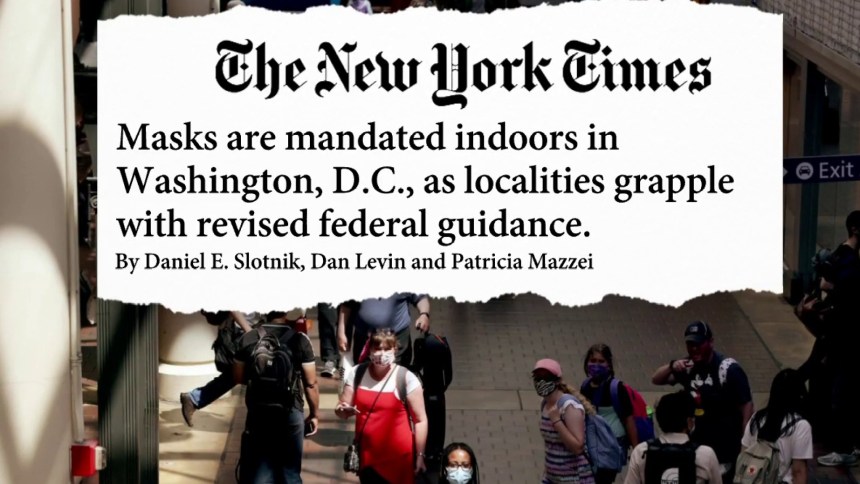
But this is America, land of the free! What happened to our freedoms and liberties? Don’t worry, we still have them, the same way we always have: in a way that is limited by our set of laws.
Would you like to have the freedom to drink as much as you want and then get into the driver’s seat of a car? What about your freedom to have a normal emotion, like anger, and then maybe hit someone as a result? And what about your freedom to do something totally innocuous like plant some beautiful flowers, even if your preferred spot for those flowers is in your neighbor’s yard? You get the picture. Your freedoms are limited every single day in big and small ways. That is not only legal: It is often desirable.
This does not mean a member of the government can come to your door and force a syringe filled with a Covid-19 vaccine into your arm. The vaccine mandates we are talking about essentially tell people that if they want to work, attend school or enter certain places, the cost of admission is proof of vaccination. Similarly, the government almost surely cannot, and should not, condition your exercise of a fundamental right, like, say, voting, on your vaccination status.
It’s time to stop the absurd “my body, my choice” arguments when it comes to vaccinations, unless we acknowledge that it limits our subsequent choices. Even the hermit who wishes to live off the grid is limited in his choices; law enforcement will come calling if, for example, our hermit starts a forest fire.
The Covid-19 vaccines authorized in the United States have been proven to help protect the person who receives the vaccination and those around them from serious illness and death. Those who wish not to obtain the vaccination cannot be forced to do so — but they can be forced to curtail their chosen activities.
If you want to work at a place like United Airlines, Tyson Foods, Google or Walmart, you must obtain the vaccination or fit within an applicable exemption. If you want to go to a college or university like Yale, Howard, Georgetown or Wesleyan, you face the same choice.
The law provides us all with choices — in this case, get the vaccine and work for the employer of your choosing and attend the school of your choosing, or don’t get the vaccine and don’t. That choices have consequences do not make those choices illegal ones.





Become a member to join the discussion