
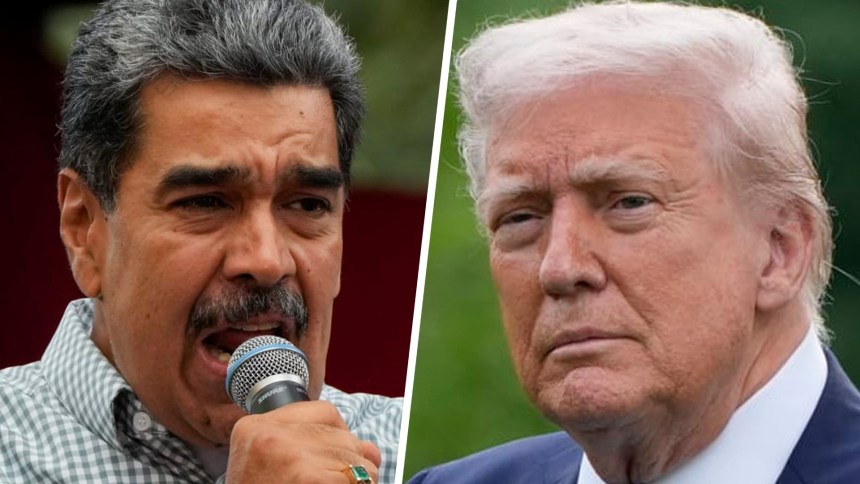
Judges around the country have recently blocked the Trump administration from deporting alleged Venezuelan gang members under the Alien Enemies Act. But what about the planeloads of people the U.S. government has already sent to a notorious Salvadoran prison under the act?
A hearing Wednesday at 5 p.m. ET in Washington, D.C., can address that crucial question.
It arises as the legality of Trump’s invocation of the wartime law falls apart in court, as judges recognize that we aren’t at war or anything like it with the Venezuelan gang Tren de Aragua. A newly declassified government memo this week further undercut Trump’s Alien Enemies Act proclamation, which claimed the Venezuelan government controls the gang; the memo shows that U.S. spy agencies don’t think that’s true.
The 1798 law has been used three times before in U.S. history, all during declared wars. Presidents can also use it in cases of a foreign nation’s “invasion” or “predatory incursion” against the U.S., but federal judges in Texas, New York and Colorado have rejected that basis for the invocation, blocking the government from carrying out further removals from their districts under the act.
Yet, these important rulings leave open the question: What about the scores of people sitting in that notorious Salvadoran prison right now?
That’s where Wednesday’s hearing in Washington comes into play, when their lawyers will press U.S. District Judge James Boasberg for relief. As to people removed from the U.S. under the act who are being held in El Salvador’s Terrorism Confinement Center (known as CECOT), they want the judge to order the government “to immediately request and take all reasonable steps to facilitate” their return.

This is separate from the case of Kilmar Abrego Garcia, a Salvadoran native also being held in that country after the U.S. government illegally deported him. He wasn’t deported under the Alien Enemies Act but rather due to what the U.S. government later called an “administrative error” that it’s still fighting against fixing.
Abrego Garcia’s case, however, is relevant to this litigation. Indeed, the plaintiffs’ lawyers cite his case, noting that the Supreme Court approved a judge’s order to facilitate his return. “Here, Petitioners have shown that the U.S. government exerts control over the people it sent to CECOT, and its facilitation of their release and return is substantially likely to redress their injuries,” they wrote to Boasberg earlier this week.
And as in the Abrego Garcia case, the Trump administration is resisting their return, even though it could apparently coordinate with the Salvadoran government that it’s paying to detain the people there. “To the extent the United States and El Salvador made a bilateral arrangement, it is not an enforceable agreement providing that the United States can obtain or retain control over aliens imprisoned on Salvadoran soil by Salvadoran guards,” administration lawyers argued in a court filing ahead of the hearing.
The plaintiffs are also seeking an order barring removal of people in U.S. custody under the act and requiring at least 30 days’ notice to challenge their designation, detention and removal under the act. The government argues that Boasberg doesn’t have jurisdiction over that class of people or the class of people already sent to El Salvador.
Boasberg initially ordered the halting of deportation flights back in March. The Supreme Court overturned the chief D.C. judge’s order because, it said, detainees must bring habeas corpus actions in the individual districts where they’re being held. In doing so, the justices stressed that detainees are entitled to due process. That led to litigation in districts around the country in which judges (appointed by presidents of both political parties, including by Trump) have ruled against the administration. It also led to the new motion for a preliminary injunction at issue in Wednesday’s hearing.
And though the Supreme Court vacated Boasberg’s previous order, that didn’t end the matter of whether government officials violated it. The Obama appointee subsequently found probable cause for contempt, and that issue is being litigated in D.C.’s federal appeals court. But whatever happens with that litigation, the government heads into Wednesday’s hearing on shaky legal and factual grounds, before a judge who already had reason to be skeptical of its claims.
Subscribe to the Deadline: Legal Newsletter for expert analysis on the top legal stories of the week, including updates from the Supreme Court and developments in the Trump administration’s legal cases.





Become a member to join the discussion