
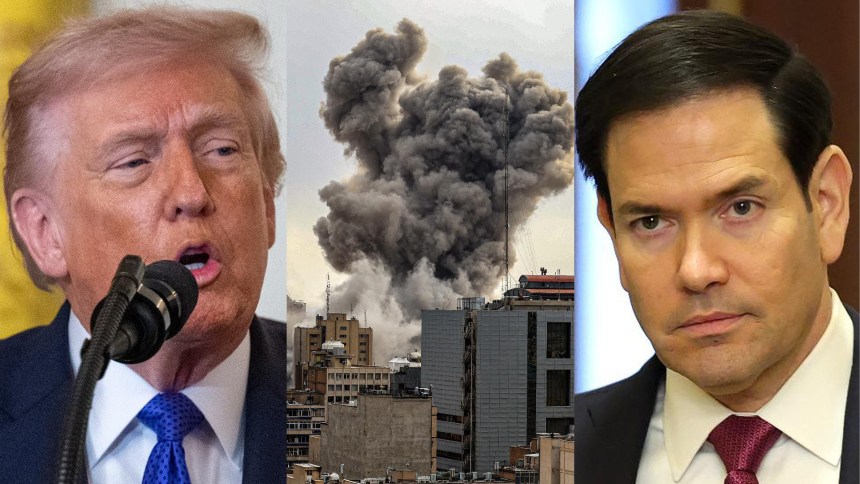
As the war in Iran got underway, the domestic political debate wasn’t just focused on whether the military offensive was wise, but also on why in the world Donald Trump did this.
Complicating matters is the lack of a clear answer to the foundational question. On Tuesday, The Washington Post reported: “As an expanding Middle East war entered its fourth day, the Trump administration gave shifting rationales for its decision to attack Iran.” A related CNN analysis added: “The Trump administration’s stated justifications for going to war with Iran were already a jumbled and self-contradictory mess. But on Tuesday, Trump made it even worse — laying waste to the administration’s confusing explanation from Monday.”
As this week got underway, Secretary of State Marco Rubio appeared on Capitol Hill and provided a classified briefing for “Gang of Eight” lawmakers about the U.S. mission. He briefly spoke to reporters about Israel’s decision to attack Iran — and the likelihood of counterattacks on U.S. assets in the region — which in turn led the president to approve the offensive.
“We knew that there was going to be an Israeli action, we knew that that would precipitate an attack against American forces, and we knew that if we didn’t preemptively go after them before they launched those attacks, we would suffer higher casualties,” Rubio told reporters.
The secretary probably didn’t intend for those comments to spark a controversy, but they immediately generated backlash in some circles, most notably on the right, for reasons that should’ve been obvious: Rubio’s description of events made it sound as if Israel forced Trump’s hand. To hear the nation’s top diplomat tell it, we didn’t launch a war on our timeline on our terms, but rather, we acted quickly because of the expected consequences stemming from Israel’s predetermined decision.
One day later, Rubio’s boss said largely the opposite. As The New York Times summarized:
Mr. Trump and Mr. Rubio both tried to smooth over tensions on Tuesday, but they continued to offer conflicting accounts of the events that had led the United States into its most expansive military conflict since the 2003 invasion of Iraq.
When asked Tuesday if Israel had forced his hand in attacking Iran, Mr. Trump said, ‘No, I might have forced their hand.’
At the same White House event, the president added, “If anything, I might have forced Israel’s hand.”
Asked about the apparent contradiction, Rubio accused reporters of trying to “misrepresent” his earlier position, but there was clearly a gap between his comments on Monday and the president’s comments on Tuesday.
It also followed a series of examples from last year in which Trump and the secretary of state were not on the same page.
Whether the apparent contradictions generate lasting political effects for the administration remain to be seen, but the larger point remains unchanged: There’s so much confusion about the rationale and timing of this war that the administration’s top voices are tripping over each other with competing answers for the public.




Become a member to join the discussion