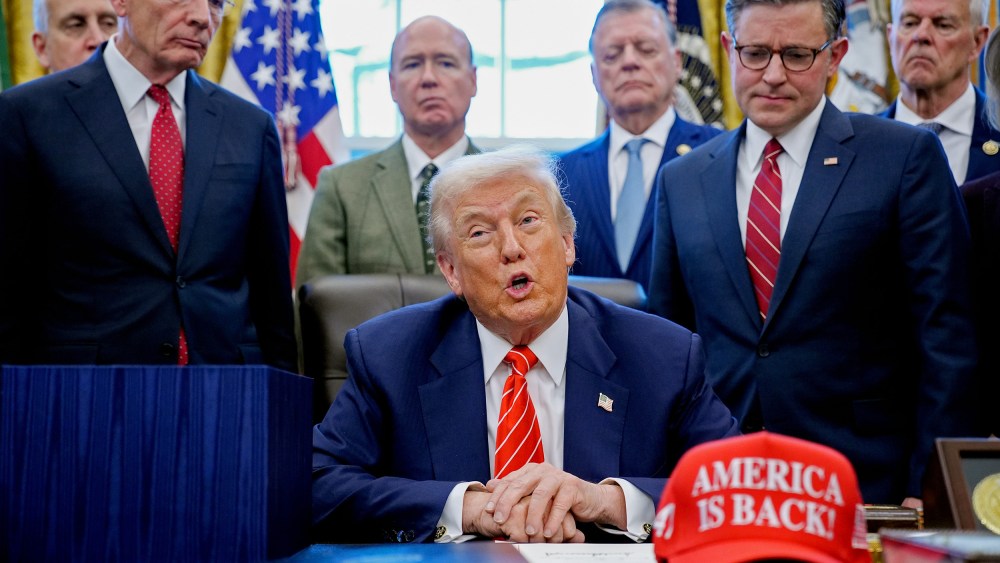
President Donald Trump signed a federal funding bill to reopen the federal government, ending a four-day partial government shutdown. The fight over funding for the Department of Homeland Security, however, is just beginning.
On Tuesday, the House passed a package of funding bills, 217-214, to fund the majority of the government, which had technically been shuttered since Saturday morning. In the end, 21 Democrats and 196 Republicans voted for the funding bills, which appropriators wrote in a mostly bipartisan fashion. And 193 Democrats and 21 Republicans voted no.
President Donald Trump — who was crucial in reaching a deal with Senate Democrats to get the bill through that chamber and then applied some much-needed pressure to convince conservatives to go along with a partisan procedural vote — signed the measure in the Oval Office on Tuesday.

The vote marks the culmination of a few drama-filled weeks on Capitol Hill, marked by deep disagreements in both parties, negotiations across Pennsylvania Avenue and the emotional fallout from the fatal shootings of Renee Good and Alex Pretti at the hands of federal immigration officers in Minneapolis.
Congress has now approved 96% of the discretionary money for federal agency budgets this year. What’s remaining is a $64 billion Homeland Security bill — which promises to be the most difficult negotiation yet.
The clock is ticking. As of Tuesday, 10 days remain for Congress to strike a deal on DHS funding, which received a short-term patch as part of the funding bill. Leaders are skeptical the two parties will be able to agree to anything in that time frame.
“We’ve got a very short timeframe to do this,” Senate Majority Leader John Thune, R-S.D., told reporters on Tuesday.
He went on to make a statement that many lawmakers agree with: “Anybody who knows this place knows that it’s an impossibility.”
As lawmakers enter the initial stages of the negotiation, his statement is starting to sound like less of a prediction and more of a prophecy.
In the wake of the Minnesota shootings, Democrats are demanding a host of changes to immigration enforcement. Last week, Senate Minority Leader Chuck Schumer, D-N.Y., laid out his list of demands: Ending roving immigration patrols, stricter rules around warrants, establishing a uniform code of conduct, and requiring officers to remove their masks and turn on their body cameras.
“What Democrats want is exceedingly reasonable,” Schumer said on the Senate floor Monday, later adding: “These changes are as common-sense as it gets.”
Already, Republicans across the ideological spectrum are swatting down those requests.
Speaker Mike Johnson, R-La., told reporters Tuesday morning that “adding a whole new layer of judicial warrant requirements is an unworkable proposal.”
Rep. Jeff Van Drew of New Jersey, the Democrat turned moderate Republican, said he’s “definitely against” having officers remove their masks.
That demand has particularly drawn condemnation from Republicans, who insist officers could be endangered by having to disclose their identities. But it’s a red line for Democrats, too, who say officers need to be identifiable.
“Masks need to come off,” Schumer said Friday. “No secret police.”
Getting this spending package to this point was no small feat. This is a continuation of the funding battle from the fall, when lawmakers fought over Obamacare subsidies and caused the longest government shutdown in history.

Just a couple weeks ago, government funding looked like it was on a glide path. Republicans and Democrats largely agreed over the spending bills, despite the fact that Obamacare subsidies were never extended, and it looked like there would be no shutdown.
And then Alex Pretti was shot and killed.
Democrats said, in order to vote for government funding, they would need major reforms to immigration enforcement.
Those changes look like they’ll be difficult to enact. But Democrats were able to convince GOP leaders to separate the DHS funding bill from the rest of the government funding package and pass what lawmakers agree on, saving that most contentious fight for later.
With the rest of the government funded until October, all attention will now turn to DHS funding. But there’s little incentive for Democrats to approve more money for the agency. For one, DHS already has a sizable pot of money from the reconciliation bill last summer, and Democrats aren’t too concerned by a DHS shutdown. President Trump ultimately has wide discretion over what portions of DHS he deems essential and keeps open.
There’s little political incentive for Democrats to fund these controversial immigration enforcement agencies.
Still, some lawmakers are holding out hope that lawmakers can agree to some sort of compromise for DHS funding and guardrails to ICE.
Others have no hope at all.
“I think that the effort to come up with a budget for DHS will be about as productive and efficient as an eighth grade car wash,” Sen. John Kennedy, R-La., said last week.